Reviews by
Carboni
137 reviews
-
 In his first Stony Man entry, the author spares no time in decimating the teams. It’s clear who his favorites are, because the survivors are characters he used before in other entries. Gary Manning is clearly the favorite among favorites. Somehow he even outranks Carl Lyons in a combined Phoenix Force and Able Team unit. The unique nature of seeing a unified team, under unusual circumstances has to place this entry as something more memorable that it probably should. The fact that a team member needs a lawyer is worth the price of the read. Just to warn you, I liked the first escape from France, but not the last one.
 -
 Two sub-par plots collide in the end and nobody is fooling anyone here. A one-page wrap up is one of the most memorable and eye-rolling of the series, perhaps. Characterization is king in this one. The rendering of a psychotic with issues was entertaining, but ultimately did not go anywhere. The overseas plot had little to do about nothing as well.
 -
 The last of the 350-page titles of this series, and literally the longest title of the franchise, “Appointment in Baghdad” is entirely in Bolan’s (or his allies) point of view as he tracks down a mysterious terror mastermind known as Scimitar. The mood and atmosphere of modern day Iraq is rendered very well, in a gripping, tense way. The plot and characterization is above average, but not a lot distinguishes from the rest of the pack. An average recommendation.
 -
 Siskiyou County, CA is the most unlikely setting of a mafia story. Bolan goes undercover to investigate an attack of a nearby air force base and also destroy a local mobster. He does the standard tricks, and improvises when the situation becomes unstable. Bolan's planning is not infallible here, and often he needs to come up with another plan the next chapter when an enemy or an ally dies. Usual stuff, only in the framework of a good, overall story and better rounded characters.
 -
 Interesting entry with Phoenix Force acting like investigators instead of an invasion force, just like the old days of CIA liaisons, a mystery and safe houses. Able Team scrambles to cover all their bases. With a good story, and an effective mystery with surprise spies and double agents, both teams burn both ends of the pipeline with a nifty meeting in the middle.
 -
 A bit boring, centering around a weapons system never to be seen (or remembered) again. The description of such weapons were deliberately vague, until the ending, when Phoenix Force is trained with their use. I don't know if it should be read as a parody or what, but the ending was a little more weird than the typical faire. This entry does point out what should have been obvious to me some time ago: One of the reasons that Phoenix Force and Able Team survive all of these gunfights is the fact they often have the technological advantage over their adversaries. In "Maelstrom", this advantage is no longer there and regaining this is critical.
 -
 Bolan in the jungle. I’ve seen this a number of times lately from this author. Even “Final Resort” had some foliage/jungle in the hostaged resort. While in the jungle, he usually has a Steyr AUG (“Survival Reflex,” “Primal Law”) and is usually wedded to a GPS unit (“State of Evil”). I haven’t read “Jungle Justice” yet, so I’m expecting more of the same there. Okay, with that said, I don’t believe I ever read a Nazi warlord installment from him. The villains were as good as they could be under the circumstances, and I liked the way the coalition this Nazi had around him to allegedly protect him, all worked together in a place called Colonia Victoria. Toss in some truly bizarre customs, some uncertainty with characters and people changing their minds with logical thoughts. They are living, breathing people that run around here. I was entertained, therefore I recommend it.
 -
 Warning: I’m spoiling some stuff. If you ever wondered what Stony Man would have looked like if LBJ or Nixon had set it up, look no further. “Patriot Acts” unveils a proto-Stony Man that probably covered itself up during Nixon’s resignation and stayed hidden. This is as close as possible to having Bolan fighting a mirror image of himself. I disagree with a prior reviewer mentioning that Bolan wouldn’t use torture (he would at the last resort) or that he would never kill a rogue government agent (one out of every four books would seem to contradict this). This author knows his subject, inside and out. This entry is recommended.
 -
 A previous reviewer contrasted this with the entry before this one, “Desperate Passage” and there are a number of similarities to this one. “Mission to Burma” is an overly complicated story, layered on top of a basic plot, complicating more than entertaining. The whole point of the exercise, the woman and the laptop McGuffin, take a back seat at the end, where alliances are formed, shattered and ultimately resolved in short order. What Bolan does at the end, he could have done in the beginning, to give him greater combat stretch. The action is good, the dialogue okay, and the plot is too complicated for its own good. I would recommend not passing, especially for fans of the author.
 -
 A new chocolate covered Stony Man with orange writing? Why, it must be an entry from Doug Wojtowicz. Able Team follows the Bull. Phoenix Force visits the Phoenix Graveyard. Anything else would be spoiling. Just when I thought the entry was figured out, it deftly pulls off into another direction, and then reasonably moves in another direction. What I can divulge is that the book contains some of the most original combat sequences I have seen to date. The author’s fourth Stony Man has fluency with our protagonists, knowledge of their previous adventures and sneaks in several references to these previous, now-classic adventures. By keeping the mystery of the Big Bad in this one a secret to the last possible moment, the title has that special sense of intrigue, lacking from other titles. Slightly disappointed with the end results, I respected the journey more. Then I was rewarded with the colorful jokers, er, villains populating the book. In terms of new characters, plot, twists, action, continuity and memorable scenes, this has it all. It will be very difficult to top this one.
 -
 With special guest stars, Rafael Encizo and Calvin James, Bolan hits the jackpot of African despots and their suppliers. Probably one of the highest body counts in recent years. Thousands of people die. The controversial ending mentioned by the last reviewer raises ethics questions that should be a topic of debate in the forums. I give points for the novelity of not being tried before. The author rapid fires a bunch of new concepts that work (an improvised catapult, for example), doesn’t work (corpse ventriloquism, for example), or just downright mean (the ending, for example). As usual: Characterization and plot, well done. Prose is good, except for conveying a sense of time and place in exterior situations (more of those in this book). Highly recommended reading.
 -
 The daunting task of introducing the lead character and making sure he is distinctive from the more famous “cousin” of the Executioner was pulled off. I liked the elements of the pseudo-retcon due to fuzzy and hazy recollections of a bunch of criminals, comparing notes. Fight scenes were brief, clever, but the main purpose of this installment was to re/introduce the character. Well done.
 -
 The most improbable villain in the history of action-adventurism dwells in this novel. “Killer Ratings” is the latest installment of the Destroyer series. Heavy handed in the political commentary and satire, this one manages to revisit a lot of the major news stories that had gone on in the last twenty years. All the obvious and not so obvious targets are not spared. Katie Couric was parodied. By my writing this review, I was even parodied. Dripping and laced with caricatures, the book fails to establish a credible threat and I can’t believe that the Big Bad in this one could have pulled this one up. Chalk this one as a comedy/social commentary episode. Not that there is anything wrong with it, but the greatest installments of the series are able to pair them with a compelling threat. Unfortunately, the series now goes on hiatus, or in the words of the authors, “a vacation.” Their publisher (Tor) did not offer another contract and the authors were already unhappy with them, they would not have signed anyways. The search is on for a new home for the Destroyer. When, or if the series will ever be picked up, is not known. This could be the ultimate installment of this series.
 -
 Camp X-Ray at Gitmo is the symbol of America in the post-9/11 world. When captives are freed by a daring raid, they launch a series of suicide missions reminiscent to the 9/11 attacks. Mike Newton utilizes effective use of the shorter form novel. Short, bloody and violent, this book details Bolan’s efforts to stop them. There are a couple of plot holes, but this author has a rock-solid hold on the characterizations. There is more suspense than body count. This entry does prove that tension, action and adventure does not have to be heavily populated with terrorist-targets. Favorite Quote (Page 21): “`All this is public knowledge. Glory to the Internet!’” Just one of the surprisingly numerous one-liners found here.
 -
 Her name is Sukarnoputri, a CIA stringer, and she has to be the most unluckiest Bolan companion in recent years. So unlucky is this woman, she’s a black hole of luck. Everything in her orbit has their luck sucked from them. Which is why this entry of the Executioner is interesting. The first and second acts of a three act book, Bolan loses his mojo. For one of the few times in the series, absolutely nothing goes right for him. The reader observes his exasperation and determination in a stripped down, brawling fight in a single night. Bolan, for once, acts like a desperate man. The novelty is gone by the third act, but the author knows when to cut it short, and brutal.
 -
 The middle chapter is where the plot surfaces and turns the story arc into a different direction. This pivotal issue is also where Stony Man Farm is illustrated, along with its core personnel. I liked the visuals and the interpretations of the building and people. The cartel appears here as well, but they run across the problem of knowing too much of Bolan’s history. For example: who really knows about April Rose and her tragic death, except for a handful of trusted people? Or put it in another way, how would they find out about her without knowing the location of the Farm? Aside from that false note, I thought the story and artwork was rather good.
 -
 The second chapter is divided into a now and then narrative shift, seldom used the in novels, and used very effectively here in the new media. Some of the scenes did not quite match up with the internal monologue. The gun battle was a little confusing of where most of the bullets were going (what were they shooting at?) kind of ambiguity. This chapter is obviously a bridge, setting up the introductions to the rest of the players for this mini-series. Brognola’s appearance was a little jarring. He did not look like how I envisioned him.
 -
 The concluding part of a two-book story. The paths of the book go in different directions, Able Team taking one path, while Phoenix Force plays out the other, in self-contained adventures that heavily reference the previous book. Phoenix Force’s mission tracks down a dangerous Iraqi threatening to take over his former country, who bought something nice with stolen Hussein money. Phoenix’s mission is one of their most compelling adventures. Able Team tracks down a crazy general. Why do deranged traitors think they can automatically be President once they take over the Oval Office? It would seem to me that every fiber of the federal government would try to kill the usurper, let alone acknowledge his legitimacy. Thankfully, someone does mention this. What I liked about this one? Since the beginning was already taken care of in the first installment, there are long stretches of just two-man teams working for fifty pages or so, working on their problem. That’s something you don’t or could not see in the one-shot books. The author presents stretches of being in one place, rather than cross cutting across several locations in a single chapter. The sustained sense of scene, place and action work very well.
 -
 The first part of a two-part story allows the author some breathing space. Phoenix Force is actually defeated more than once. Able Team screws up, kind of. Since there is another book coming, liberties can be taken. It’s not the battles, but the war. The locations are vast and varied, South America, Mexico, Nevada, Texas, Hong Kong, Korea, U.K., Israel, etc… Both teams end up splitting up their members to cover all of this ground, reducing their effectiveness, something that is observed, but never stated directly. Characterization is good. The action scenes are above average to standard issue. But the pace kept a good, thrilling momentum. I thought a MOAB stood for the Mother of All Bombs. Erika Dukas is apparently introduced in this title. She resurfaces again in an Executioner novel, “Deadly Contact” as the central character. Able Team also sees some international work, a rarity. The attack of Bucklow was haunting. I also mentioned this in the forums, but a little title trivia: This is the only Stony Man title (to date) to start with the letter G. No Executioner or SuperBolan title (to date) has ever started with a G.
 -
 Cool cover, great characterization and a hardboiled writing style keeps the plot churning. The blood and thunder truly begins in the last third of the book. Gore, larger-than life characters, this one is not for the squeamish. The highlight of the novel is where the big bad goes basically from house to house in the local town, recruiting a mercenary/criminal army to try to stage an assault on Camp Triangle, only to have Bolan trailing him, one house behind him, burning their houses down. The ending was a bit rushed, the viewpoints and people got jumbled up on the mountain, and the last three pages are puzzling to be sure. This can be overlooked because of the cool cover, but this triangle has no depth.
 -
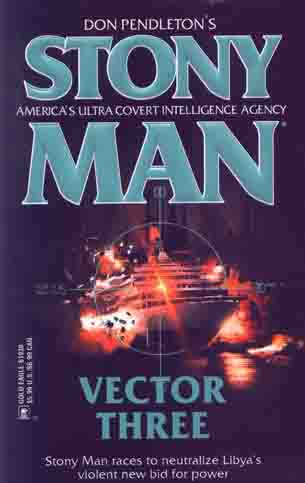 Special Guest Star: Colonel Khaddafi And Introducing Jayne Bahn as a reoccurring character. After a lengthy hiatus, Ron Renauld, a former Able Team author, returned in 2001 to write “Vector Three,” a well crafted Stony Man novel. Of all the current writers, I consider him the complete novelist. He writes fewer pieces, but makes up for it with his excellent (and expansive) plotting, characterization and detail. Only his action scenes needed improvement. This novel has a surprisingly good number of set-piece action sequences and plot threads. Intriguingly he divides Phoenix Force to separate members, embedding themselves with the multiple storylines running throughout this novel. With five members of Phoenix Force, Able Team and then Bolan/Katz in the mix, there are large number of ongoing threads that run into each other, merge, and shoot off in different directions in unpredictable ways. A logistical nightmare to write, I’m sure. Multiple continuity references, including one to his Able Team run, works well here. He even expands the continuity with Hawkins’ own past as a Ranger. A few of the passages were very long winded and exposition-filled, but not enough to get in the way of the enjoyment of reading this novel. Recommended.
 -
 Able Team fights the Blue Moon Phoenix Force stops the Shin Bet Realistically, this novel has the most plausible Killer-Satellites-Of-The-Week. Sky Hammer simply drops a huge rod from orbit and by the time the kinetic kill rod reaches earth, it can go Mach 2. The problem, though, is in the details. The details are hit or miss. And when the miss here, they stick out. Here are the misses that I caught: The kinetic kill rods have a targeting system. The steering rockets of the rods are useless when the Earth’s atmosphere burns it up, so targeting isn’t an issue, but the accuracy is. No steering rockets, wind-conditions, earth’s rotation, etc…Stony Man is revealed to have the ability to “blow up the Internet.” Yes, they identified the 16 key areas to kill it for “months.” Other details, from the top of the head: McCarter was never an officer, but he is a pilot. Hawkins isn’t a pilot. Plasma screens are mistaken for LCD screens. Field-stripping a laptop does not require the butt end of a pistol. Water will kill a hard drive. How did Able Team know their protagonist thought of himself as royalty? Every member of Stony Man had a piece of dialogue with them racking the slide of their sidearm. Even Lyons who is known to carry a revolver? Did he rack the slide? Page 303: “Placing the wicker basket on the gravel, Lyons pulled out his .357 Colt Python and racked the slide.” There are a couple of imaginative action sequences, especially when the antagonists try to kill the action teams with intricate death traps. Worth the price of admission and reading the novel from cover to cover, especially the creative way they tried to kill Able Team. One of the best sequences and reactions in the series. Heck, the first two attempts on their lives are memorable. (More than makes up for the horrible end to the novel. Massive points reduced for the worst ending ever) I liked that sections where they were cut off from the Farm. I also didn’t realize that Wethers is Mr. Spock. This makes sense, the entire “cybercrew” which is the biggest flaw of the series, I sometimes envision them in the bridge of one of Star Trek series. Intense dialogue, commands, technospeak, buttons that really don’t do anything and lots of pretty graphics. It’s really easy to do, especially when they use the Hubble telescope (spelled correctly here) as their periscope into space.
 -
 Twenty-five years after its first publication and time has not been kind to this novel. The rating is based on my contemporary reading. Smiley Dublin is the world’s worst federal agent who gets captured two too many times. Where are the other Ranger girls? Why hasn’t the Ranger Girls been ever serialized? These questions and more kept me occupied while I read this by-the-numbers entry. All of the elements are here. The differences are striking - Bolan is more emotional here, more angry, than his current incarnation. He also carries a lot of aliases (four) for this short work. The newer novels are better written, light-years ahead of this one. This author did improve over the years. Massively. And he knows his stuff. How this is tried with the first thirty-odd novels are interesting and diverse, a true sequel to the classic stretch, before they proved to be static emulations. Bolan was never threatened, but Smiley was. Also, for all of the insidious and carnal nature of the white-slave trade, why no mention of Cindy?
 -
 Awesome. The author has the Bolan undercover thing down cold here. (He infiltrates a Blackwater-type outfit in Afghanistan in this one). Nobody in the current writing stable does it better. Every time he cranks one of these novels out, he improves his formula. For most of the novel, I expected Bolan’s cover was going to blown and a firefight was about to erupt. Tension with a capital T. The main protagonist is a formidable one, breaking new ground, a hotheaded alpha male sniper. Colorful allies that you care if they live or die. Throw in a female love interest and a rogue’s gallery of villainy, and you have “Ambush Force.” Aside from the military super-macho-USA#1-patriotism, and I give a direct quote to one example: “`If the US Army Rangers are after you, you’d better have a weapon of mass destruction, because that’s the only way you’re going to stop them.’” (p.25). And this quote is coming from no less than Bolan himself. There are other comments that seem strangely out of place in this series. And the last assault in-country was one too many, with the ending scene just right. I highly recommend this one.
 -
 His name is Gil Favor and Joe Pesci would be playing him if this was a movie. “Extreme Justice” is part Lethal Weapon 2, part the Sopranos, mix in some fundamentalist Islamic terrorists and serve it in Costa Rica. The author’s characterizations and dialogue are always welcome to this reader. The sociopath Casale, so effective, but so hot-headed and armed with those wonderful witticisms. A few of the twists are telegraphed in advanced, it is just the matter of seeing how it all plays out is the fun of this adventure. Bolan never strays from his course. For most of the novel, he is the Justice Department enforcer. In the conclusion, without giving too much away, he remembers that he once was the Executioner, somehow making the first ninety percent of the novel a moot exercise. Strangely, #357 of the series does not have a .357 magnum in it. If you like tiny fonts, this one is for you.
 -
 Special Guest Star: The League of Extraordinary Spies Absurd to the absurd power. Not a single word written about every population in the world would be screaming and in massive panic mode that killer UFOs the size of apartment buildings are going around and destroying all of the space facilities in the world, shredding armies and turning their attention to various famous landmarks by the end of chapter two. This highly absurd threat is strangely compelling -- and you know that everything will be back the way it was by the next novel. It’s like Captain Nemo showing up and blowing up the Eiffel Tower and the Statue of Liberty. There are a number of clever twists and surprises by the audacity of the villains here, but the reader is tempered with the knowledge that none of the damage will be permanent, ignored or discarded by the next novel. The threat in this one is more suitable as a foe for the Destroyer, Doctor Who or Stargate SG-1 The Stony Man action teams are barely in this one, making appearances close to the 100 page marker. Phoenix Force’s first appearance is the only scene out of order with the rest of the story, as if there was a mandate to have all teams in the story in by the first act. With all of that said, this will go down as a wholly original, compelling and entertaining story. The novel moves fast, zips along quite well. And it generated something I haven’t experienced in some time: tension. I kept wondering how were they going to stop this one. I only wish there was a threat something that didn’t seem like the doomsday weapon one builds to end their Command and Conquer game. Strong recommendation, but hopefully this story is never copied/imitated. I docked a point for “a thousand” heavy machine guns and the lasers all going off at once… The first of the slimmed down 320-page format.
 -
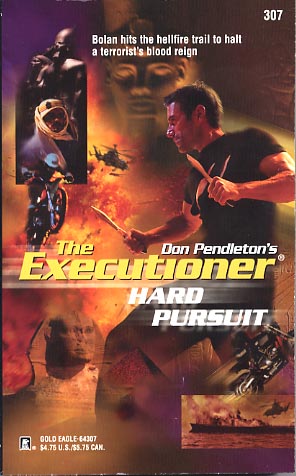 The author’s second book does not have the sophomore slump. A wildly entertaining, unpredictable pursuit across Egypt, Bolan and some incidental partners are put through a bloody endurance run. Excessive violence, dialogue and pop culture references actually begin to wear out their welcome after a while (just after the Agents Johnson and Johnson referencing, of course, Die Hard). I did like the continuity between other novels in the Stony Man series, and Bolan recalling Able Team missions and Phoenix Force members like he actually knew them personally. Characterization is just a tad off, but this is something I do not see in his followup novels. This novel is built like a movie, complete with a snazzy pre-credits sequence (not literally of course), crazy stunts and one-liners. The basic urgency of the chase is primal. Not bad for a second effort, and by all means, a recommended entry.
 -
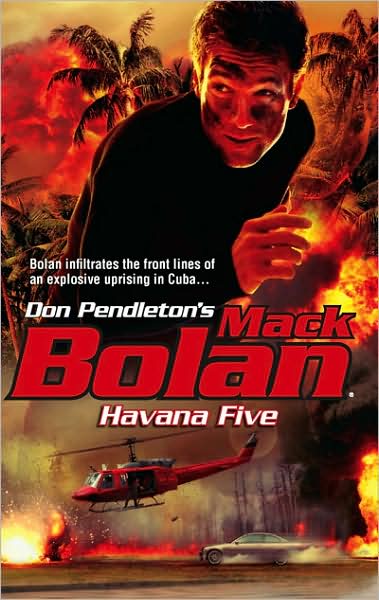 Special Guest Star: Rafael Encizo. Havana Five is the name of the most powerful cartel in Cuba. One of its members is up to something, so Bolan’s personal mission is to change its name to Havana Zero. He is sanctioned in this one, bringing along some assistance, most importantly with Encizo. They partner up and enter a maze of lies, treachery and deceit. Encizo had some very good scenes, stepping out as just one of the five, and into the spotlight. The characterizations of the reoccurring members are good, even the President managed a surprise in this one. Some of very colorful characters appear in this installment. I will remember Stein and Crosse for a while. I am a little amazed on how easily Bolan and company could operate in Cuba, perhaps too easily. The usual editorial mishaps appears here as well, the 3-round burst from a Desert Eagle tops the list. Oh another qualm, Inez Fuego is a little too sex crazy, under-mining her character development, making her into a throwback caricature. I give this installment a slightly above average recommendation. First of the reduced page count books.
 -
 Able Team dances with the Shangri-La Lady. Phoenix Force smashes an underground railroad. Self-contained Phoenix Force episode meets a self-contained Able Team episode. The links between the two big bads are miniscule at best. An average entry of the series, the author does manage a couple of surprises for each team. I also liked the moments of reflection of each main character and the way the plans are scrapped and changed on the fly. A touch of realism goes a long way. This novel would have benefited with a slower pace with even more characterization. The overall plot is very unremarkable and underwhelming, and I may have trouble remembering it three months from now. I would consider this an average entry of the series. Unintentionally amusing scene: McCarter drinks a Coke and smokes a cigarette. He spends a paragraph field stripping his used cigarette, and pocketing part of it for fear of leaving his DNA behind. Then seconds later, has no qualms of crushing his empty coke can and tossing it away into a waste can (leaving his … DNA … behind.) Notes: Contains yet another example of Carl Lyons being misnamed, a reoccurring mistake in recent years, by possibly bad editing. Last of the 350-page Stony Man novels, a span from #2 to #95.
 -
 Started out strong, but devolved into a James Bond imitation. Breaking point for me was during a ludicrous escape from a Vegas hotel. Brognola is dressed impeccably for some reason. He’s Mr. Exposition in this one. Bolan also never upgrades his weapons. He runs around the novel two-fisting his Beretta and the Desert Eagle, even when pitted against armed terrorist and/or mafia camps. Temporarily without a Beretta, he runs around with a PPK and a Desert Eagle, two-fisting. I liked the author’s first installment, but I’m coloring this one underwhelming. First of the slimmed down Executioner novels. Other than a reprint, this would be the first 192-page Executioner since Blood Heat Zero published in ’86. It also had a snowy cover.
 -
 Bolan scrambles across America in search for a Nazi superweapon. Where or how the superweapon was created, don’t go looking for the details here. Primarily the novel is a rather interesting character study of the current Nazi movement in America. No points awarded for the double gimmick. This is one of the few from Mike Newton in recent years that didn’t involve a jungle crawl and a Steyr Aug. Also contains no femme fatales. Also addressed: Bolan’s reluctance of using civilian allies. I have railed against using sidekicks for the sake of partnering up Bolan with a fresh face. Other authors deploy them regularly. But this author’s firm grasp of the character is true to the lone wolf nature. And it shows what would really happen if a civilian gets caught up in Bolan’s world if, and only if, he managed to talk Bolan into taking him along. I recommend this overlooked entry.
 -
 On a routine execution of a Triad mobster in Hong Kong, Bolan uncovers a mysterious “project” that mobsters are killing to protect. The novel is a lean, fast ride with zero-percent fat content. This is a calorie burner that can be easily read in two or three extended sittings. The plot is freeform, imaginative and characterization is authentic to what we’ve seen before. The opposition is smart, and relatively early on, recognizes the threat that Bolan poses. I like the way they hold their disbelief in check and treat him like a real threat. This is the last of the 225-page Executioner novels. Beginning with the next installment, the novels are reverting to their early/mid-‘80s size. Ironically, I remember the penultimate 192-page novel, “Defenders and Believers” where the opening chapter sets up the rest of the book in almost the same way. With one important difference, in “Outback Assault” is set up by a happy accident; in “Defenders” it is by design. What was common the early series, the undercover operations and subterfuge are uncommonly seen in the latter novels. If they are used, they are used for a single scene or a couple of chapters, not at any appreciable length of the novel. I’m glad that the author revisited this tradition. I recommend this unpredictable book.
 -
 Bolan undertakes a personal mission to check in on an old army buddy of his, only to be blinded in the process. The author probes deep into the psyche of Bolan, of coping with a disabling injury. Mike Newton’s depiction of Bolan's mind is bedrock solid. There is only one false note, where Bolan had never considered a disabling injury, thinking/worrying about the fatal injury, something I do not buy. This novel explores the disability angle that no other novel has done before. The jungle politics of Brazil is a bit muddled. Light on action, this is a survival drama that questions putting one’s life on the line for a duty for a higher calling. I would consider this novel a mixed bag, but solid characterization and ruthless action decides this one. Speaking of bags, I am glad the author forgoes the usual bag of tricks and instead of the gunshot wound (to the side), a bout of blindness is a challenging change of pace.
 -
 A coded transmission, a limerick, is Bolan’s clue to track down a madman who is assembling ingredients for a weapon of mass destruction, a nuke. Ingredients are one thing. Components are another. Nothing in terms of who, when and where are mentioned with the building of a bomb, so this lunatic was still years away. Inexplicably, Bolan enlists a non-combatant civilian to be his sidekick for this one, basically against the man’s will based on a hunch and a need for a buddy. The Executioner attempts to train him in the ways of combat like a sage master of the combat. Bolan tries to get this civilian-journalist killed dragging him from one combat situation after another. And the combat situations are horrible, reading like live-fire shooting ranges striking down cardboard cutouts. The supposed simultaneous attack of dozens of hostile guns right at the heroes, two human-sized targets, caught by surprise no less, and absurd results follow. Twice this happens in the first half of the book. The second time, with the shanghaied rookie in tow, with more guns waiting for them than Butch and Sundance, and yet the jaw-droppingly dumb results continue. I know that these aren’t supposed to be a realistic, but this is by definition a gun fantasy that damages the quality and reputation of the title. I would not recommend this one. Some of the worst combat situations I’ve read about. I gave the author points for dialogue, literacy, prose and the puzzle of a limerick.
 -
 For the usual Death-Satellite-of-the-Month, this one has a far more ambitious plot than most. Instead of screwing with GPS, this one triggers nuclear weapons from all over the globe, no matter where they are. Phoenix Force and Able Team are barely in this one. This is strange, because Bolan is not in it at all. The teams are in large, subplots for most of it. Page for page, perhaps the lightest in terms of their involvement in any other Stony Man I’ve read. What replaces them are aside plots, of leaders grasping at straws, of hapless military men who get incinerated, of victims who seek revenge, or contingency plans to confront the world threat. It gives the work a broader scope, but with little follow-through, a scattershot atmosphere. I sometimes thought the author was trying to win a bet, to see if he could write a Stony Man marginalizing the main characters for as long as possible. For those who endure: Able Team and Phoenix Force resurface in the last third to finish up with some decent and prolonged fighting sequences. Editing is also weak. Cod word instead of code word. There are two (or possibly three) separate men named Sakir Elsani running around in this novel. I’m thinking it’s not the Albanian version of John Smith. Dubious science and technology weakens his hand. (Note to author: LCD screens are the most popular computer monitor in the world today. Plasma screens are popular mostly in living rooms. A plasma display for a laptop? There is no such a beast.) I’m not convinced that blowing up a nuke next to another one would cause a chain reaction. And if I was convinced, then the concentration through accumulation would make each nuke chain-reaction more dangerous than is depicted here. Not to mention the political/social fallout of these events, that would have far, far, far more consequences than a 9/11, and should have ramifications for decades to come. I’m not convinced I will see that either.
 -
 As far as Destroyer novels are concerned, this one is out and up there. At 280-pages, the biggest yet for their Tor Books era. With a tiny font size, this one is probably the longest in decades. Remo and Chiun face off against radical terrorists. Instead of going up the random terrorist of the week, they go up against the legendary 20th hijacker from the 9/11 infamy and a thinly veiled version of Cindy Sheehan. Not exactly the high-powered super-villians they have faced in the past, but these folks are only the minions of a seriously dangerous and knowledgible threat. And they even provide insight in each of the four main character's backgrounds. This novel even tackles the question never before raised: Who is buried in Remo's grave? Characterizations are solid here. The plot is compelling and unpredictable, at times politically incorrect and the satire is highly polished. Must read stuff for fans of this series.
 -
 Mike Linaker scored the continuity jackpot here. A jaw-dropping total of six characters from his previous novels reappear, with four characters returning for the first time from (a highly regarded novel of his). This novel is the closest thing to a sequel I’ve seen in this series in a long, long time. Though with that said, “Patriot Play” runs more like a conventional Bolan novel. Here, Bolan and Lyons dismantles a hate group trying to overthrow the government. The entry offers the usual in terms of high-level action scenes, although the sortie into Africa was a bit too episodic/random for me. It offers an entertaining portrait of a militia leader losing his mind and his temper, the trials of the smooth double-agent operator Riback who thought he had everything under control, and a contrast between Bolan and Lyons’ styles. The wizardry and the marvel here is how many previous characters can one cram into a novel like this without making it appear like a forced reunion. The answer appears to be right at six.
 -
 A portrait of a Russian mob family who likes to bump off federal witnesses, this novel rarely strayed from a very thin plot burdened with groaning coincidences. Does every Russian know each other? And well-worn clichés: a mafia princess coming into power. The author has the action scenes down pat. With each novel I read of his, the more I appreciate his prose and economy of writing. As for the story? About mid-way through, I thought I knew all the steps, but he surprised me two steps from the ends. The conclusion contained a couple of surprises that notched this up from mediocrity.
 -
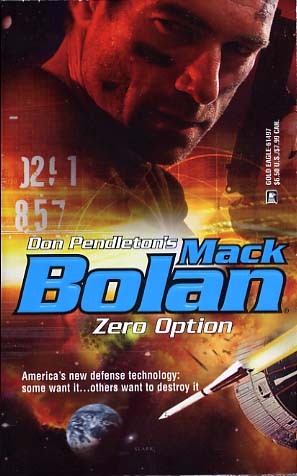 A lot of references to the Six Million Dollar Man, if anything, this novel played out like an entire season of 24. This entry is a mover, from fluid action to powerful narrative, once the mid-point is reached. The mechanisms and absurd coincidence to set everybody up in one place was a little hard to take. Once past this point, this little rollercoaster zoomed along, in a logical, compelling rate. I have mixed feelings about the sci-fi aspect of the plot. The details about the fantastic technology were glazed over with philosophy and Zen. But there was no harm, no foul. The Ryan henchman is a stand out. I also enjoyed the crazy General with his speeches. Above average entry, bordering on great.
 -
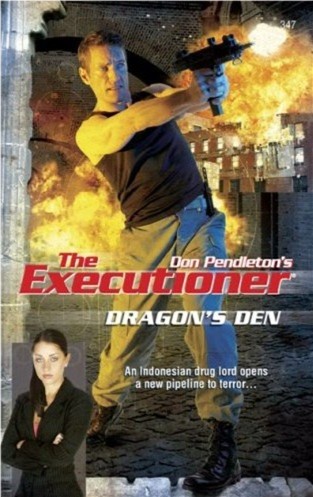 I was surprised on how much of it was not set in Indonesia. This, and a few other twists, one I did not see at all, provided a good framework of a story here. I was also surprised throughout of the weak rationalizations. For example: with Phoenix Force in town, ready to go, why would Bolan use them as backup and have local talent to be his wingmen. I have problems with this in other books, not from this author, but it is something I can justify it as keeping character count low. Or possibly it implies that new characters from one-shot books are more compelling because they can die. But the logic is faulty, leaving one of the best anti-terrorist teams in the world on the side, wanting to instead make a go at it with some rookies. Unlike the other reviewers here, I will not fault the author for wrapping it up quickly in the last chapter, the change of prose worked for me. This is an slightly above average entry, but a must for Brognola fans, whoever you are.
 -
 Do not overlook this novel. There are no nukes of the month, Muslims of the week, and yeah, the world’s population is not at risk. This remarkable novel uses the least worn areas of the series. Different, to say the least, the entry frequently uses horror, savagery and plays to basic fears, with even a little dash of mysticism tossed in. This new Acapulco blitz has a number of surprises, twists and cliffhangers that I could not put down. Another wrinkle, one of the main villains is hidden in plain sight like an old episode of Columbo. This layered cake of intrigue rendered to life with effective writing here has to be regarded as one of the top books of the series. As always, I also liked the relevant references and links to classic stories from the past. (I would like to give it a bonus point for being set in Acapulco, a city that I had a chance to visit for the first time only a couple of weeks ago, but I couldn’t get that slider bar up to 11).
 -
 The timing of this novel is problematic. The last title in this entry had a very similar premise with a number of parallels and coincidences, even right down to the nationality of the enemy commander. Comparing the two, I believe that this one is slightly better, not drawn down by the gadgets and gimmicks of the first one and a more realistic reaction to the nationwide calamities, simultaneously occurring, leaving the Stony Man teams a bit thin. A roll call of all the Stony Man teams are fielded here, new ones, old ones and not-so obvious ones. The cyber-team is the only unit I still have problems with, and I am still amazed Price still has a job after the stunt with Air Force One towards the end. Even if it was not exactly what it seems, not telling her supervisor before it happened (or during) should have be firing offense. The broad scope and action also gives the novel a different look and feel. After back to back world-killer threats, I would appreciate a novel that takes a different tact, to show a smaller-scale action could be just as emotional and more relatable. I got lost a few times in the underground fighting, where detail of scene and surroundings often gave way to speed and expediency. I do appreciate the author not only tying into the classic novels from the eighties, nineties and today, but also his own previous works. No other author has tried this in fifteen years for either Able Team or Phoenix Force. He succeeds in creating his own niche, his own universe here that lives, breathes and remembers where it came from. “Deadly Payload” is the latest installment and I eagerly anticipate the next one.
 -
 Phoenix Force and Able Team wage war against an unknown threat who has hijacked the worldwide GPS system. A wide-sweeping mission, brought down by its own preposterous plot and strange gimmicks. I believe that the author did not do his homework on this one. The technical details are not fully explained, appearing to be a shortcut method, than a lack of time or resources. The world-wide calamities that are ignited in this one, mention after mention about regional warfare, are brushed aside in a vague comment. Is the world still at war? For the amount of effort, and essentially the entire purpose, to keep the peace, did the effort fail? In Chapter Sixteen, an attack on a legendary American base is about to commence, but not a single word about the outcome. Then there are the gimmicks. Strange, high-tech, highly implausible, toys that Able Team deploys only draw attention to themselves. Taking a swipe of Hollywood for being unbelievable, then with the same breath, the author purports that a terrorist with a backpack laser has the properties of a mobile sun, capable of blinding in all directions at all times. Phoenix Force’s mission comes off better here. They are enemy agents in a nation without diplomatic immunity. Their resourcefulness and more logical, plausible and technical details serve them well. Their passages are the best part of this marginally recommended entry.
 -
 The greatest action-adventure parody takes on the cigarette industry, to hilarious effects. There is also a credible threat to the incredible men of Sinanju. The authors’ only false step is when they toss in a couple of mysteries of no surprise or consequence. I highly recommend this one, because of the first-class parody, the first-class opponents with their colorful backgrounds, and a lot of Sinanju history that is covered in the course of one novel. The characterization is as sharp as ever, especially since Warren Murphy, who co-created the series, had his hand in the writing of this novel.
 -
 This one was a pleasant surprise, after a rocky start. The first part of the novel was not in focus. The point of view time-shift all over the place on the timeline. Very curious. When it does calm down, it settles into a nice focused story involving Phoenix Force as the second act of the novel. Phoenix Force’s mission invading China was good. Dragon Slayer makes an appearance. Previous novels relied on Dragon Slayer as a crutch, where Phoenix Force (or another Stony Man team) would be less effective, capture-prone or about to be all killed, only to have a state-of-the-art, unbelievable aircraft arrive to bail them out just in the nick of time. This phenomenon does not occur here, thankfully. Other than the structure of the novel, which I enjoyed, I also approve of splitting off a member of Phoenix Force and temporarily attaching to Able Team. And splitting a member off from Able Team, and so on. That was fun. What was not fun the reoccurring character of Mei Anna. I often thought a female member of Phoenix Force would be a compelling, interesting addition. Mei Anna showed me ways on how this could be a bad idea. Phoenix Force is often described as the five best anti-terrorists, covert-operatives and paramilitary types. In recent years, they have been only in strike force mode. This novel has one exception, where one of them plays spy, while the others play commando. He didn’t have a good time playing spy, but this reader did. I also liked the use of reoccurring characters and hope this is more of the norm, than a special occasion.
 -
 “Vigilante Run” had the promise of a new author, interesting premise and a lot of good buzz. Unfortunately, to me, the book plodded. Gary Rook parallels are obvious to a certain famous vigilante. He has the lines and the outline of one. However, as a character in this novel, he is a simpering, humorless knockoff, with a pathological need to blow away bad guys, with absolutely no moral code whatsoever. No concept of innocent life, even though it is key to the one motivation he draws upon, indicates an incomplete character profile. As evil-Bolans of the month so far this year, he has to be the most insufferable. This entry had no high concept ideas, no sense of menace and the worse of all sins, boring. The exotic locales of upstate New York and a wacky plot involving Chinese sleeper cells venture into a weirdly underwhelming third act. Ironically, the action slowed this one down. The dialogue and setup expositions I had no problem with. Save for one. Chinese sleeper agents are not called at home and told “You are activated.” Just like that. I try not to focus too much on the errors, but that one stuck out. The pacing are choppy. The action scenes are sketchy, not well-fleshed out, and the characterization of Bolan is a bit off. Strange enough, his Desert Eagle is set to “stun”, instead of to kill. All of this is understandable for a first time author to the series. I would read future installments from this author. As an introduction, this left me a little cool to anticipate the next entry.
 -
 A wildly unpredictable hunt for a fallen ex-patriot, “Ripple Effect” is from Mike Newton. Newton gives his fallen soldier, Talmadge (how do you pronounce that again?), a complete background. His psychological details and the personality infused in him presents a character that is something more than the evil-Bolan of the week. From the beginning, he has a Homeland Security operative team with him. A boy wonder, Dixon is Robin, to Bolan’s Batman. He is in constant awe of Bolan, and so there are many opportunities to explain the series through a series of male bonding exercises. The first act in Jakarta was a bit random, by the numbers, with a so-so car chase. The second act in Vancouver was the best part, where the title comes into effect. That leaves the third act. I will not give away the ending. There is a lot of tension, especially with the choices made by the antagonist (his first choice was electric) and the unpredictability of the end. Very well done for a series novel. And, in spite of all this, is still entertained. Very good.
 -
 Special Guest Stars: Blancanales, James. Chuck Rogers’ “Blood Tide” is a sword-happy, crazy entry to the series. Even Bolan privately admits that this his undercover assignment is the “biggest lie he ever told.” Indeed it is. No other entry has strained its credibility for an audacious, bold story set in the waters of Southeast Asia. The novel is memorable for the imagery invoked, including the creative use of an Ontos tank destroyer without treads. A long time ago, I had a plastic model of an Ontos and it went without treads for the longest time until I got around completing it. The ending of “Blood Tide” was super weak. Let’s just say that I wanted a few more pages of novels to depict them handling the medical emergencies, given the place, injuries and logistics involved. What I liked was the PRC angle, the exotic settings and the detailed history described throughout. I also approved of the Chosen Men storyline. Did not see that one coming. The author took serious gambles to manhandle and contort the plot to something never seen before. I really liked the middle of the novel, but it’s the weak-ending and the liberties taken to set it up cannot be easily forgotten. Exceptional novel, brought down by the weight of its own preposterousness.
 -
 Alan Philipson wrote the formative installments of the former action-adventure series The SOBs. He also wrote, in my opinion, the greatest action-novel that I’ve ever read, “Red Hammer Down.” “Red Hammer Down” was the revenge story of spetsnaz going after the SOBs. The protagonist mercenaries’ mission was to simply survive a horde of spetsnaz soldiers. “Red Frost” is another revenge tale carried out by spetsnaz soldiers. This time using a nasty piece of biological warfare called Red Frost. The author is in fine form here. The action scenes are masterful, especially the centerpiece action revolving around the siege of Large Marge’s fine dining establishment. The personalities are a tad flat and the specialties of each character are a bit scrambled. This is understandable and forgivable to an irregular contributor to the series. The biggest flaw was the way the simple plot unraveled into loopholes and unexplained motives. Was this more than a literal and figurative suicide mission? You be the judge. Very morbid. Very grisly stuff, but strangely authoritative and vivid. The author does not check himself when it comes to language or gore. I give Red Frost a very strong recommendation, but by no means a perfect entry.
 -
 First time Bolan author Peter Spring provides an actual story to this Executioner entry, “Orange Alert.” Using a dirty bomb is one of the few worn clichés he uses. “Orange Alert” is entertaining, engaging and goes along very sprightly for the series. His characterizations seem real and his command of varied subjects indicate detailed research. There are a lot of flaws, starting with the way the Bolan is sometimes handled. He seems more like a spy than the real Executioner. For example, there is a part in the novel where Bolan’s trail goes to a mobster, who has to be the most clueless mafia enforcer this side of the Executioner series. The background information of him killing federal agents and killing assorted members of a federal judge’s family, a Bolan in any other book would have been ashamed for not just going after him when this happened, but he would have been extremely upset that Brognola did not tell him. There are a number of plot holes and weird writing choices. More words were spent describing a safehouse in Ireland than were used to create all of the subsequent scenes that took place there. And come to think of it, this has to be one of the longer Executioners spanning over a couple of months. It only took him four to five days to find and defend a lost Mayan city in the previous installment. All in all though, the author provides memorable villains. One of them is a mirror of the mafia-wars Executioner, and another a parallel of the current incarnation of Bolan. It's an interesting choice what he does with those characters. I recommend “Orange Alert” for the fresh storytelling. His style and prose kind of reminds me of a Ron Renauld and Peter Leslie’s best work. Hopefully he will write more Executioner titles. His first one was decently good.
 -
 The closest thing to an Indiana Jones adventure that The Executioner could go, this entry could have been called “Raiders of Site X.” Mike Newton thankfully makes only one direct reference to the famous archaeologist. The plot is creative enough. Mayan gold is financing terrorism that kills an American citizen. Enter Bolan, who is tasked to deprive the terrorists of their treasure, and if he gets a chance, deprive them of their lives. Like “State of Evil” this is a Bolan in the jungle adventure. This is a welcome break from the atypical nuclear weapon and Arabic terrorist scenarios. I typically enjoy this kind of adventure, when they strip away Stony Man and all of the supporting personnel. Then fill the space with newly created characters. Only Brognola makes a cameo. This creates an isolated, surreal atmosphere around Bolan in his travels. Newton’s Bolan characterization is bedrock. Bolan’s cautious nature never crosses into paranoia. The author’s has the usual style of posing a series of what if situations in everyone’s head, illustrating the intelligence of the players involved, as they make their strategic decisions. “Primal Law” is fast paced, light on combat, but strong in supporting characters. The story of fighting over a lost city is very immersive. And very good.
 -
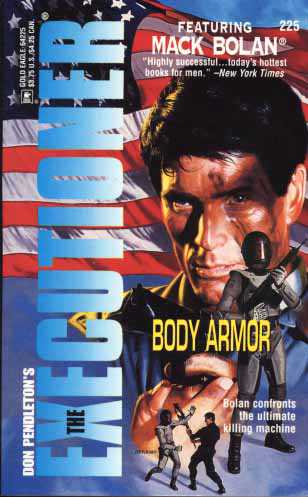 William Fieldhouse’s wildly experimental novel about a gang of fascists who develop state-of-the-art body armor and call themselves the Juggernauts receives credit for imagination. Fieldhouse, who pretty much is responsible for shaping Phoenix Force in over thirty stories, contributed to a few Executioner titles before his retirement. Of all of his post-Phoenix Force novels, “Body Armor” would be his most passionate effort. He strays away from his usual antagonists, terrorists and ninjas. He creates a threat to Bolan that catches even the veteran soldier by surprise. He changes tactics repeatedly, creatively grasping at straws with determination. However, the prose is a little tough to go through and the obligatory hand-to-hand sequences are one too many. And the villain was too narcissistic to be considered a credible threat.
 -
 Special Guest Star: El Hombre “Border War” is a continuation of Bolan’s El Hombre campaign started in “Blood Vector.” Here, he tracks down a mysterious warlord known as Omega. The main villain is a cunning, and sharp operator. Chuck Rogers’ love of El Caminos is more evident in this one, not one but two are featured here. References to the French Foreign Legion, El Hombre, Canada and presumed dead American military personnel resurface here. One of his more common traditions does not show up, thankfully for the Executioner, who has lots of toys to play with in this one. This novel is wall-to-wall action. By the time I reached page 37, I would have seen the conclusion of no less than three medium-scale skirmishes. Up until the last chapter of the book, it was unpredictable. The inclusion of a handicapped ally, enhanced the chaotic uncertainty on how the plot would play out. Definitely one of the better entries.
 -
 Jumbled in a mess of continuity errors, technical inaccuracies and some sloppy Gold Eagle editing, lays the heart of a good story. I liked that the twists were happening to everyone in the story, rather than just the protagonists. What I did not like were passages like: “Delahunt fondled the air with the cybernetic gloves she wore, opening files.” (p.44). She needs a better query tool. And since when does McCarter have an SAS tattoo? And what happened to Encizo? “Encizo was less than handsome, his face carrying the scars of too many battles. But the looks beguiled the razor-sharp mind inside.” (p.80). Poor Encizo, he’s been also given a minor role in this novel. The last few chapters seemed like it was hacked to death by Gold Eagle editors, who apparently used a chain saw rather than reading it. Carol Lyons? Come on. The story is solid, and with some radical streamlining here and there, the pace flowed. The tight race against time for both teams had the tension and captivated me. The better action scenes are found in the first two-thirds of the story. This is a good idea, hobbled with some problems at execution. The editors really let down the author on this one.
 -
 Bolan plays rough with an all-female assassin group called the Elements of Death. This is a fun, unique entry that was utterly and completely unpredictable. I had no idea where the plot was going. It’s a rare event in this series to have a plot that is not standard issue, instead given an original, non-linear idea like this one. The setting of a major U.S. city, interesting villains and a lessons-learned reprise of the “Tooth and Claw” finale are all bonuses. If Stony Man ever contemplates to add a female member to one of its strike teams, this book alone should answer all arguments. No other novel in this series featured as many female warriors. Members of Phoenix Force and the secondary members of the series are given meatier roles here. Characterization is rock-solid, and the action scenes have not been better from this author. “Double Play” has to be considered as one of the best entries of the main-line Executioner series. This one clicked with me. Highly recommended.
 -
 A new author, Nathan Meyer, finally returns Bolan to his lone-wolf nature. Unlike recent entries for the series, Bolan does not pick up an ally for the entire novel. Although, the first-time author has not yet picked up the characterization of Bolan (too much scowling), but given time, he should. His pursuit-chase scenes are the highlights of the novel. They are well written. Meyer presented a good first start, with plenty of room of improvement. The last part of the novel has the mangled remains of heavy editing. The twenty-third chapter is one of the shortest I’ve seen. The story is a largely irrelevant Chechnyan mess, light enough to not get in the way of the smooth flow of the novel.
 -
 The Destroyer is back. After four years of self-imposed exile, he has returned to fulfill his obligations to his country. Just in time for the latest, greatest threat to the country. General Santa Anna is back. After almost two-hundred years, a namesake is carving his own country between the border of Mexico and America. Warren Murphy, who hadn’t written a Destroyer novel since the eighties, is back. He is the co-creator of the series. James Mullaney is also back. He had a successful run in recent years. The satirical edge of the series is back. For a novel written last year, it has the ripped-from-the-headlines story about immigration across the Mexican border. They defend both sides, and make jabs to both arguments. No safe harbor for anyone. A Ted Kennedy and a John McCain stand-in are also present. The authors cheerfully play with fire here. If you are interested in the subject and you are reading reviews of this website, then do yourself a favor and read this book. The main threat for Remo is the only woman who has ever killed him. Chiun thinks she’s smarter than Remo. She is the best part of the novel, a true sociopath with a magnificent mind. Her methods are a match to the normally under-matched Remo. Everything else is good times. What I do not like is the long back stories of people who are in the periphery of the novel. Nor do I like the reasoning and logic of traitors in the government, who should have been hanged for treason if anything went wrong. This is the first novel under Tor, after 10+ years under Gold Eagle. This novel sets aside the last four years under a ghost writer who did not have the blessing of Warren Murphy. This is intended to be the restoration and the return of the Destroyer of old. The magic of these books is back.
 -
 His name is Dawud. And he has to be the most stupidest terrorist mastermind I’ve ever read in an Executioner-verse novel. Hands down. At times, I thought I was reading a parody or a satire. He kidnaps a nuclear expert and a few other decoys, but forgets which one is the expert? And he can’t tell a bunch of white guys apart? Bolan believes that you need a nuclear expert to make a dirty bomb. That’s all you need. One expert. No ink is wasted here explaining that a dirty bomb is simply radioactive material surrounding a bomb. A nuclear expert is kidnapped in Amsterdam by terrorists and its up to Bolan, and the expert’s brother, to find him. The twist? The terrorist’s don’t know who he is yet. Jerry VanCook’s previous entry, “Tropic Heat” had Bolan teamed with a Texas Ranger. This time his partner is an Army Ranger. I remember a time where Bolan didn’t have a partner-of-the-week. Anyone remember the term lone wolf? The same complaints I had in “Tropic Heat” resurface here. Bolan acts too much like a rookie. His highly-trained partners appear to be green recruits tainted with cockiness. Here Bolan’s own investigation style involves no heavy-mental lifting. He uses the President in such a way to blow his cover. He thwarts a random hijacking attempt that has nothing to do with the rest of the mission. Bolan also overlooks the mysterious murder of one of his informants, after being clubbed unconscious, being shot in the head outside a room with a firefight. A supposed stray round killed him, but Bolan and his buddy did all the firing. Who killed their unconscious ally? “Splinter Cell” has some attempts of comic relief, but the plot is very slow and bloated. I offer into evidence the thirty-page chapters and three small-scale firefights. The entire novel is small scale. So is the grade.
 -
 A nuke goes off in the Australian Outback. Stony Man Farm is attacked by elite hackers. Intelligence agencies are panicking. Because the hackers are traceable, Able Team is dispatched to find them. Phoenix Force is in the middle of a mission in Dagestan. My thinking is, what about that nuke? It’s ultimately disappointing to report that those two story-threads were the most entertaining part of the novel. The more I learned about the plot, the more I did not want to know. All roads (story-threads) eventually lead to the mystery of the nuke in Australia, of course. But the route taken is one that’s not to be desired. Space-aged weaponry weighs down Dan Schmidt’s attempt of an epic story. The unbelievable claims and powers of the world’s governments compromised the novel, a fatal breach that ends up sinking it before the finish line. Nukes have gone off before the series. So has space flight, futuristic technology and outlandish government conspiracies and alliances. This one attempted to readdress those all at once. Previous opponents make an appearance. All of them. Russian & American black ops, corrupt UN officials, The European Space Agency, a reusable shuttle project, Russian mafia, Islamic fundamentalists. The novel strains and creaks, trying to tie them all into a Mad, Mad, Mad World of evil doers. Most of the prose is a bit mangled, making reading this a bit of a chore. The editing is off here as well. Taglines notifying the reader of locations disappear from time to time, ultimately being dropped all together. My favorite goof is from page 220: “Blancanales gauged the distance to the [aircraft] – about eight hundred yards out, plenty enough within the four-hundred-yard range of his platoon-slayer.” And why did McCarter really needed a knife to kill that terrorist commander? I enjoyed the first hundred or so pages, but it declined real fast after that. The rest of the novel, well, let’s just say the final grade is an overall average.
 -
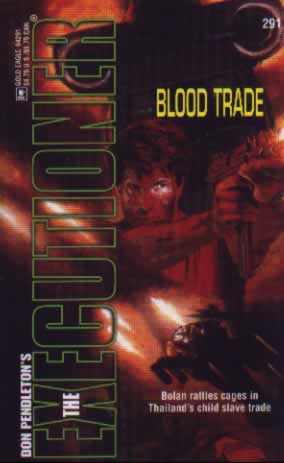 Douglas P Wojtowicz’s “Blood Trade” novel takes on child-sex slavery rings in the Southeast. For Bolan, who draws upon the memory of his sister, the mission quickly becomes personal. The Thai warlord he is pitted against is General Chang Chi Fu. His heroin operations were previously destroyed by Phoenix Force in the Paul Glen Neuman’s “Slow Death.” Chang barely escaped at the very end of the novel. Neuman stopped writing Phoenix Force novels after two more installments. General Chang Chi Fu became a forgotten footnote for sixteen years, until Wojtowicz revisited him. To reintroduce this back story, Katz makes one of his last appearances in the series. So does a few other Stony Man regulars to make the first act of the novel a collaborative effort among protagonists. “Blood Trade” has a huge amount of violence and combat situations, far more than an average entry. Bolan is presented here as a three-dimensional character who remembers his previous adventures. Wojtowicz’s characterization of Bolan is one of the better ones. In fact, I would rank it second only to Mike Newton’s contemporary Bolan. This is a very well done entry of the series. His first effort does not have the polish of his later novels. I give him a lot of credit for trying something special in the tradition of this series.
 -
 Jon Guenther’s “Sensor Sweep” is an imaginative scenario that places both Stony Man teams to their limits. What began as a dry-as-dirt investigation, turns on a dime and becomes compelling during the second act. “Sensor Sweep” is a story about balancing duty with vengeance, and how sometimes they are like oil and water. Characters take surprising turns and development inside the framework of this novel. None of the changes are permanent, but fascinating to watch before they reset when you close this book for the final time. The qualms I have is that the boat-loads of terrorists are mostly unarmed. Phoenix Force blows away three coming this way. Able Team takes out two charging that way. A handful depicted do have a guns. A Phoenix Force member gets caught by surprise, forcibly disarmed and then the terrorist draws a knife to finish him off? The last chapter is also seemed a bit strange and off-beat for the novel, and the series. All in all, I would recommend this novel, especially fans of the author. I consider this a better entry than “Vanishing Point” another navy-centric entry of Guenther’s that was released only four months prior this one.
 -
 In a terrorist raid in France, Phoenix Force uncovers a drug pipeline emanating from Turkey. They correctly figure that Turkish intelligence is compromised, so they use German intelligence while in the country. For this purpose, Karl Hahn is first introduced to the series as their liaison to Turkey. I’ve recently re-read this novel after reading this originally a couple of decades ago. William Fieldhouse’s prose seems especially clunky and embarrassingly overcooked. He uses words like thugs, lowlifes, guy, brutes instead of pronouns. Keeping in mind this was written over twenty years ago, I am not going to be especially critical of the writing style when it comes to the rating. Fieldhouse’s prose is still developing. His plot structure here is basic, but Hahn’s solo chapters and the assault on the castle are the highlights of the novel. “Phoenix in Flames” is the best title of the series, too bad it wasn’t saved for “Tooth And Claw” where it would be more apt.
 -
 Mack Bolan combats an international conspiracy involving cattle, North Korea and Salt Lake City. “Contagion Option” is the continuation of Douglas P. Wojtowicz’s anarchist cartel saga that was last seen in “Extreme Arsenal.” Bolan’s characterization is dead on here. His rage for the horrors he witnesses in North Korea fuels him throughout the novel. The was the strength of the novel is whenever he was depicted The biggest problem I had was of one of the main characters, a protagonist, named Stan Reader. He is a super-genius, super-athlete type. If Aaron Kurtzman and Gadgets Schwarz had a love child, he would almost Reader. And if Uncle Grimaldi taught him how the fly. And if Uncle Kissinger gave him a Class III weapons license... he would be Stan Reader. His flaws are strengths. He is paranoid, but that just makes him prone to buy a lot of weapons and security systems features. He also uses big words. Or as he may say: utilizes a larger range of vocabulary. The Talented Mr. Reader joins two FBI agents to form a neo-Able Team for this mission. He lobbies hard to recruit them from the beginning of the novel, presumably, so they can go on their own adventures in a spin-off book series. With such a powerful ally, the trials of the Executioner here were not challenging as they could have been. Reader is too deep of resource to find this story not very compelling. However, I would also have to recommend it.
 -
 “Lethal Payload” is a rather imaginative entry in the Executioner series. Very different type of storyline, with a nice mystery at its core. I had two major problems with the book. Like all the reviewers before me, they mention the massive amount of punishment that Bolan takes at the end. What is puzzling, is that the wounds and injuries seem to be forgotten through the last two or three chapters. With an occasional reference here and there, the injuries no longer have any presence. The injuries he took were not stitched together or bandaged for several hours, it seems he made a partial recovery. He did not have anything personal at stake to write it off as a personal mission. Nothing about this mission demonstrated that he took any of it personally. The other problem I have is that this Bolan is different. He is not a “calculated risk-taker” like in his predecessor novels. He is a bold, all out, risk taker with methods I find strange, even for him. You would not mistake this Bolan with, picking a random example, Mike Newton’s Bolan. He also smiles a lot... actually, the word is “grins.” But the story was imaginative, creative and flowed really well. The action scenes, even knowing that he really gets screwed up, made for some tense reading. If it weren’t for my two problems, this novel would have scored very highly. The story’s twists, turns and revelations created enough goodwill to fully recommend it.
 -
 In “Deadly Contact,” Bolan must save a Stony Man Farm interpreter from a evil conglomerate of Bosnian war profiteers and retrieve evidence for a mass execution. What makes this outing notable is the complexity of the plot and the background behind it, but then again, the rest of the plot is paper thin. I enjoyed the “survival” scenes in the snow and the final action sequences. I was disappointed with the several loose ends. The major themes of the Executioner series are judgment and sacrifice. I will not name character names. But by leaving their fate in the air like that, undercuts this. “Deadly Contact” moves fast with some notable action, but ultimately is an average entry. I haven’t read a Mike Linaker story since the Phoenix Force adventure, “Dirty Mission” fifteen years ago. I intend to read a lot more of his work.
 -
 “Nuclear Reaction” is an average Bolan entry where he blows away opponents by the truck-load in Pakistan. It’s another nuke hunt, but thankfully they call it Project X throughout the novel, a nice substitute for a well-worn word. I also enjoyed the Newton usual characterization of Bolan as a paranoid bastard, who would rather walk a couple of miles out of his way just to avoid taking a risk. “Nuclear Reaction” is a novel about pain and sacrifice. Interestingly enough, Bolan is surrounded by three-dimensional characters complete with love triangles and motives. They bare the brunt of the pain and sacrifice of a better future for their country. Shades of the original Star Wars movie. Brother. Sister. Evil empire. Rag-tag rebellion. Against a technological terror. The name of rebel group is Ohm. Why? Because it’s the symbol of scientific resistance. Nicely done.
 -
 Jerry vanCook’s “Tropic Blast” is make it up as we go along adventure. Bolan is partnered with a blacksuit trained former Texas Ranger. They go undercover into Columbia, without much sanction, and try to locate and kill a sleazy narcoterrorist named Pepe 88 and his government informer. There are a lot of dead-ends in the pursuit. The main underlying question is.. Could this really be Bolan? He sure acts like a rookie in this one. Unfortunately, the answer is yes. The novel is sometimes nothing more than a sloppy love letter about Texas Rangers. In this novel, Bolan’s Ranger are infallible, Mary Sue (or Marty Sue here) types. If Stony Man were to lose one of their teams, a couple of Rangers would fit right in nicely. In fact, Bolan opts to go with the lone Texas Ranger instead of a perfectly good Stony Man team on standby only miles away... The bottom line is that this is a slow, plodding adventure with some very weak moments. Above average for this author.
 -
 Back in the Eighties, when the teams had their own individual series’ of books, a handful of writers were given multi-book runs. William Fieldhouse, had enough latitude to kill off Keio Ohara and create a new Phoenix Force member from scratch. GH Frost used his run to create an epic story arc. Several Able Team and Stony Man writers have come and gone, none of them were able to capture the magic of the GH Frost run. “Extreme Arsenal,” Douglas P Wojtowicz’s second Stony Man entry, does not quite capture the magic, but pays homage to Able Team’s roots in nothing but flattering ways. This novel is a long-deserved (sort of) sequel to the events depicted in the GH Frost epics. And it’s also a continuation to Wojtowicz’s own emerging storyline. He is quietly building one from his body of work. Shhh! Don’t tell Gold Eagle. I have grievances to the absurdly random way McCarter entered into the novel, the preposterous plot, and the sheer magnitude of references from books past. That doesn’t really matter. It’s an action-adventure, not a plot-and-ponder. All is forgiven when I am given the opportunity to witness the Cowboy Jihad rise again.
 -
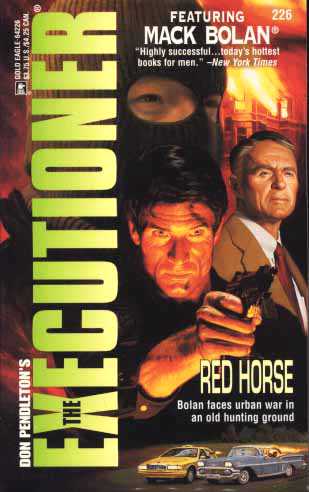 Will Murray’s only Executioner novel to date. This was published right after he was released from writing the Destroyer series after a successful ten-year run. I’ve read them all. Therefore, “Red Horse” was interesting novel for me to read. Murray’s Executioner is more of a studious, planner-type than I’ve seen lately. The rest of Bolan ring’s true to the sense of characterization and motivation. “Red Horse” is about an arson gang outfitted with killer cars and mysterious motives. The entire point of the novel is learning the secrets of the Red Horse killers. As a mystery, it was sufficiently twisty and held the interest. It had a dash of the off-beat, a sense of humor and social commentary about cities. In this case, Boston. I wish I knew more about Boston. There are at least fifty streets that are named in this novel. I’m not exaggerating that much. If I lived in Boston, I probably would have scored this a bit higher. There are some in-joke Destroyer references as well. One notable example, Bolan’s safehouse is identical to a long-time (ironically torched as well) safe house of Remo and Chiun. Right down to the same location. I sense this novel is more of an experiment than a resume padder. Experimenting to see if he can write an Executioner novel. Experimental to see if he can create a novel dealing primarily with dueling cars. Something he would not be able to do with a Destroyer novel. “Red Horse” was a quirky with some very good moments, but decidedly average frame of a story. I would rate this novel the same way if a John Smith would have written it.
 -
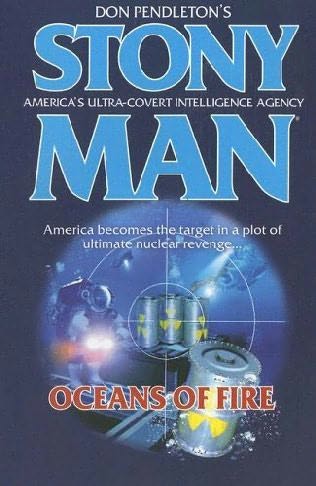 Chuck Rogers’s first Stony Man novel, “Oceans of Fire” does not disappoint at all. In the Bolan books, he frequently uses a single representative of Able Team and Phoenix Force. Here, he fields the complete teams for the first time. He portrays each team with different styles. Phoenix Force has the code names and the advanced spy tactics down cold. They even show a few new tactics. Able Team are a bit more undisciplined and cowboyish. After a hundred pages, I had to take a break. Rogers stuffed enough plot into those first one hundred that I felt like I had read a full novel. Don’t get me wrong. It’s a good book. In any other’s author’s hands, there is enough material for a two or three Stony Man entries. The densely packed material is slow going compared to other books. There is no padding. Only plot developments. The plot develops into a monster of a beast. This is now the high-water mark of the Stony Man series. Not bad for his first try. What I did not like? The Geek love saga. What I did like? The numbers. Deyn, the villian, is exactly 68 years old in this novel. He would be the same age as Bolan had he aged. The first Executioner novel was first published 38 years ago and Bolan’s age was established at 30. Coincidence? I also like the moments that the heroes really believe it was over for them. The author pushes both teams to the limits. Favorite quote of the novel. Made by the villian... “‘Your team was magnificent, but it’s over.’”
 -
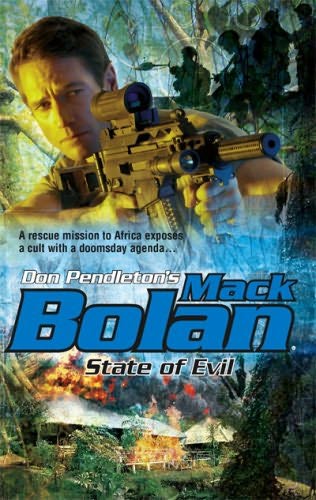 Mack Bolan is convinced by Val Querente to kidnap a former student of hers from a enigmatic African cult leader named Gaborone. Bolan heads to the deepest jungle of the Congo and retrieves an unwilling disciple. Bolan (not-so) quickly finds out there is a nuclear weapon in play, and the best laid plans of mice and Bolan are put on hold. Thus is the situation of “State of Evil” an overwritten but focused novel from Mike Newton. Parts of this novel is one part cult awareness drama and two parts Tears of the Sun. With a nuke. There is an obligatory Osama wanna be who makes a cameo appearance. But what works with this novel is the sense of focus, of a cult warlord trying to make sense of his situation, while Bolan negotiates the jungle with his charge. It’s a good chase novel. The story is believable and stands a nice change of pace for the series. It’s not a far-flung, overcooked potboiler. It is very basic, very primal. It works well. Ninety-five percent of the novel and a hundred percent of the action takes place in a relatively dense jungle. As for continuity, Bolan’s relationship and recap of his relationship with Val from Pittsfield to their last meeting in “Fatal Error” is rehashed, with some surprising revisions/oversights that I’m surprised Newton would make. Leo Turrin’s wife (and not mobsters as this history reveals) shot Bolan in Pittsfield.
 -
 Ron Renauld is the best pure writer in the current Bolan rotation. His novels are populated by breathing, three-dimensional characters that propel a deep, involving plot. “Homeland Terror” is no exception. The plot involves Operation Clean Sweep, where an evil senator launches a plot against the local militia movement for his own personal interests. Very well crafted, with an interesting twist at the end. The action is sparse here, and the underwhelming ending would have fit better as the end of a John Grisham novel or an episode of Law and Order. I did have an issue with the blacksuits of the farm being involved in a federal raid. With all the media attention in the books, it almost destroyed their cover, the entire Stony Man operation... for what amounted to be minimal gains. The biggest problem I had would be that Bolan had nothing personal invested in here. He acts more like a Fed than his own man. The Executioner of old would have, you know, executed a few people here and there. With that said, Renauld wrote a good novel here, but the emphasis was not on justice, but with the poetic justice.
 -
 In the previous novel, “Infernal Revenue,” Friend calls the IRS to investigate Folcroft. Folcroft is raided from the opening chapter. The majority of the action revolves around Folcroft, the IRS raid and their growing Rogue’s Gallery of master criminals they have sedated in the sanitarium. Doctor Smith tries desperately to retain his cover, preserve CURE and prevent the IRS of releasing their dangerous inmates. This is the first novel that Winner Smith is introduced. And its also the first time that two master criminals from two other novels, meet and help each other out in a jam. It’s interesting to see the continuing arcs set up in the previous novel, dealing with the aftermath of all the damage caused by an now off-line computer program. Just imagine if two or three of the Rogue’s Gallery of Beasley, Friend, Gordons, Dutchman or Krasheevah would have combined forces. A whole slew of new possibilities are revealed with this novel.
 -
 This Destroyer novel brings back the enemy known as Friend. Friend is an AI computer program whose motive is profit. In an earlier novel, he kills of his programmer/creator because he was spending the profits. Increasing profits is what Friend does. This is its third appearance. This time, he learns from his mistakes. Friend targets CURE and their agents for destruction. He does a masterstroke job of pissing off Remo, stealing Sinanju gold and cutting them off from the White House. In other Destroyer novels, Remo and Chiun usually no contests their way through assassins, soldiers and criminals. Only supernatural threats give them a run for their money. Like no other time, they are so utterly defeated, divided and routed, this Destroyer novel surprised me. Because of this, this has to be considered one of the best stories of the entire series. Excellent.
 -
 Squirrelly Chicane believes that she is the reincarnation of the Bunji Lama. A thinly veiled version of Shirley MacClaine - a well-known believer of past lives, Squirrelly returns to Tibet to take her rightful place. She is also high as a kite throughout this Destroyer novel. Remo and Chiun face of the Chinese military, to protect her. There are not a lot of real threats, but funny situations and social commentary, particularly of the Chinese domination of Tibet. This is the first Gold Eagle Destroyer novel.
 -
 Learning that an old Vietnam buddy is possible still alive as a POW in Vietnam, Remo ventures into locate him. However, he is afflicted with amnesia, remembering nothing of the past twenty years. Remo really believes he is in the Vietnam era. Hilarity ensues. This novel was a bit of a letdown of the epic of Line Succession. Finding POWs is one thing, but Remo’s memory lapses caused by independent events wear kinda thin. This is more of an attempt to be a Return to Vietnam type of novel found commonly in the eighties with tepid results. The highlight is that Chiun gets an elephant. He calls him Rambo.
 -
 The quintessential Destroyer novel. Epic. Taking place during the 1988 Presidental election, Bush and Dukakis are tipped off about CURE, and they promise to close down the extra-legal agency. When their assassination attempts are thwarted by a mysterious ninja, the Dutchman, both CURE and Sinanju appear to be on their way out. The Dutchman is the most powerful human being ever to face the Destroyer. He is the yin to his yang (hard to explain). He knows Sinanju and he has the ability of illusion. The Dutchman challenges Remo’s claim to be the successor of Sinanju. While this problem manifests, Remo is ready to be married to Mah-Li. He is stunned to learn that a lover from his past has returned, to reveal his first-born child to him for the first time. This novel introduces Freya, his daughter. Could she be the heir of Sinanju? Tectonic shifts of the Destroyer universe occur in this novel. Nothing is quite the same. This is a pivotal point in the series. “Look Into My Eyes” is the best novel, this entry is the most pivotal. The title, “Line of Succession,” says it all, lining up the successors of the US Presidency and Sinanju.
 -
 This Destroyer novel came out in the mid-eighties, right before the age of computer gaming. This novel is the satire of the console game and home entertainment consoles that were common in households during this time. A renegade computer programmer/video game enthusiast has created a game of his own amusement, where lives are worth points, and his entire goal is to kill, kill, kill. Remo is worth 50,000 points. Abner Buell is trying to start WWIII for reals. He is Matthew Broderick's WarGames character with a criminal intent. He also shares a lot in common with Friend, such as hijacking bank terminals to “communicate” with his victims.. Other than that, he is a one-trick pony. The book is short, fast paced with the ending, all the more predictable. An easily disposable entry, however, “The End of the Game” does have social commentary that is relevant today.
 -
 “Look Into My Eyes” is my favorite Destroyer novel. Vassily Rabinowitz has a mystical power of instantly hypnotizing people with eye contact. He escapes the Soviet Union to hide in the United States. After initially attracting the criminal element, he becomes super paranoid and uses his powers to acquire all the allies he could. Because his powers can easily trump Sinanju, he is one of the most dangerous adversaries Remo and Chiun had ever faced. Chapter after chapter, he gains more allies and no character is immune. Remo’s training (lasting for a couple of decades) concludes in this novel with a mystical experience. But the real star is Rabinowitz. Instead of an unstoppable Remo and Chiun, this is an excellent showcase of one of the most popular non-reoccurring villians of Sinanju history. There are pretty edged and satirical commentary on influence peddling and lobbying. It’s not what you know, it’s who you know
 -
 “Lost Yesterday” is a parody of Scientology back before the parodies of Scientologists were in fashion. This Destroyer novel is a devastatingly satiric and brutally funny. PowerEssence have developed a substance that makes people forget. This substance is used to defeat the organization’s enemies. Not satisfied with that, they contract their services to the mafia for a fortune, to make government witnesses also lose their memory. The church leader, Dr. Rubin Dolomo, is as paranoid as he is insane. The complication to this novel is that Remo himself contracts the substance and forgets who he is. This novel is as contemporary as there are Scientologists around.
 -
 Sergeant Mack Bolan returns home to bury his family. He also ends his life as a civilian, and becomes a fugitive for justicer. A well-told origin story of legendary Executioner. It’s a shocking read. Not only is Bolan a civilian for the first and only time (he even had an apartment), but he is a green rookie in his early days as The Executioner. He makes mistakes. He is a cocky, grinning guy who swears his revenge. Pendleton details out specifically his moral code of honor and conduct, of Bolan’s sense of duty and justice. This is the touchstone of the rest of the Mafia wars and of the character himself. There is also a shocking amount of sex in this entry. I did find it a bit much that he would seek/have enjoyment in the same brothel that his sister worked at. But that does not matter. This book is critic proof. This is the first entry of the most successful and prolific action-adventure series of all time. This is a glimpse before he becomes battle-hardened, before the modern Bolan. If you look for it, there is also a glimpse or indication what would have happened to Bolan if he had not taken arms against the Mafia.
 -
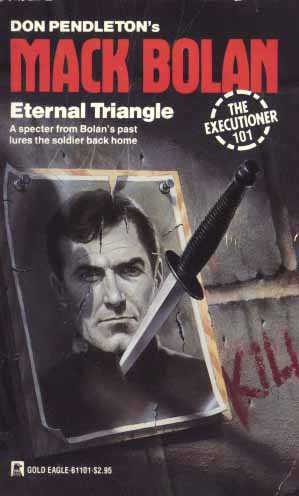 I reread “Eternal Triangle” as a companion piece to the first novel, “War Against the Mafia,” exactly 100 entries prior to this work. Mike Newton’s modern Bolan as a consummate professional, a world-weary veteran of a hundred campaigns, stands as an amazing contrast with the first novel. What’s ironic is that as I write this, his current incarnation is a world-weary vet of over four hundred campaigns, and he looks as young as ever. In “Eternal Triangle,” Bolan is lured back to Pittsfield for the third time in the series, retraces his old steps of his very first campaign. Because I read the first novel right before this, revisiting the sites, the names and the meanings now carry sentimental weight. Light on kills, strong on story. This features one of the best pieces of storytelling of the Executioner series. Also, check out the cool cover. Eternal Triangle’s structure is also parallel to the first Bolan campaign. To help him out, Weatherbee, the homicide detective who dogged him in the first novel, is here for him. There is also the haunting, memorable cameo of April Rose, “his one true love.” This also marks the first time a descendant of one of his kills would come back to seek revenge. I suspected at the first time I read, it wouldn’t be the last. But the floodgates didn’t open. The story of a man who lost his family member is a grotesque parody of Bolan’s own ordeal in the first novel. The symbolism, the sentimentalism and a story well-told make this a must-read entry of the series. For all intents and purposes, this is the last entry of the Mafia wars. According to the story, “Eternal Triangle” takes place approximately eighteen years after “War Against the Mafia.” This is where the Executioner literally stops aging, and becomes a timeless figure like James Bond or Superman.
 -
 Special Guest Star: Gary Manning Bolan is dispatched to Canada where a flesh-eating bacteria had surfaced. He quickly uncovers a mob connection to a larger, terrorist scenario. Chuck Rogers, who wrote this, weaves an excellent story with his signature, sharp, punchy writing style. Wit is abundant. So is an uncommon (to the series) dose of sex and humor. In “Terminal Zone,” Bolan faces a very credible threat, not the usual bus-load of inferiors. Carlo is his peer in this one. Their confrontation at the lodge is the highlight. Just reading the lodge chapter is worth the price of this book. There is a wealth of humor and lethal surprises, as Bolan convincingly almost buys it. Twice. He also has a memorable run in with a porn star (not really what you might think). I really can’t think of any negatives. Perhaps the usual fuzziness from Rogers’ novels of how much time actually elapses from scene to scene. This is really enjoyable. Bolan faces more twists, turns and surprises than an average entry. It also has a fantastic finale.
 -
 Special Guest Star: Carl Lyons Mara Salvatrucha, also known as MS-13, is an El Salvadoran street gang that plays a key role in Chuck Rogers latest installment, “Blood Vector” Innovative trap plays from both sides, quick pace and punchy writing style reminded me of the classic Able Team adventures of G.H. Frost. Instead of the usual Phoenix Force field rep, the Ironman himself accompanies Bolan on this terrific adventure of blood and betrayal. I had two serious problems with this novel. The shooting down of the jet was too far-fetched to make it work. I couldn’t swallow that one. The second objection I had was with Erasmo. A military officer who lost something so personal like that (and I won’t be the one to reveal what or why) and be persuaded to join another cause, I could not believe a conversion so quickly. The conversation was not presented, only mentioned in a throw away line, made this flaw even more evident. The strengths of this novel are too numerous to mention here. Chuck Rogers has to be considered one of the top three writers of this series. The highlight concepts would be the Glock ploy and the best scene would be the escape with the El Camino. I also like the possibilities of seeing a large, expansive and dangerous street gang like MS-13 in future installments. Bolan states this in the beginning. “They’re no longer a bunch of street gangs. They are a mafia.” Indeed.
 -
 A small percentage of drugs are being intercepted by the United States. So MERGE’s Columbian chapter decides to ambush DEA teams. If you kill enough DEA agents, drug interdiction would be suicide assignment. So goes the master plot of “The Nightmare Merchants” one of the better Phoenix Force entries by William Fieldhouse. Phoenix Force goes undercover here. A different kind of undercover compared to “Harvest Hell.” They follow up the pipeline, into an unsanctioned (by Columbia) mission, alone, without allies into drug country. What they discover in the Columbian jungle is a Cuban-MERGE alliance, and with them, Captain Raul Encizo, the long lost little brother of Rafael Encizo. The entire plot is engineered into a surprise meeting between the two, and the payoff is not here, but in a future entry. I liked the twists and the betrayals, and the work Phoenix Force does in Columbia. So often are they guests of the country, complete with diplomatic immunity, governmental liaisons and everything is greased for them. Here, they are effectively enemy spies working in the shadows. For some reason, I can’t really describe, everything works well here.
 -
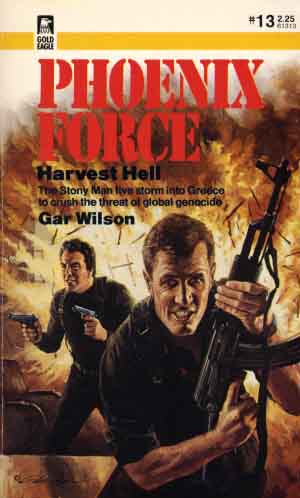 Able Team and Phoenix Force were assembled to apply Bolan’s tactics into the terrorist world. This is Phoenix Force’s attempt at the Executioner’s practice of hardcore undercover work, also known as role camouflage. True, they’ve always use cover names, but that’s to maintain operational security among other friendly agencies. This is different. This is undercover work with cover identities for Manning and Encizo to infiltrate Krios Island, a biowarfare facility run by the KGB. Because of this, this turns out to be a very good spy story . Phoenix Force divides up: two members undercover, the rest engage in their usual shoot and scopolamine investigation. The weakness was the unnecessary but obligatory pre-mission scenes that had nothing to do with the story, except to show that Phoenix Force members in normal situations. For example, sharks attack James and Encizo. Okay, a reach, but I can accept it. But at the same time, some bikers with poor judgment decides to mug Manning. Katz also has an unusual situation of death in public, but this one had something to do with the plot. “Harvest Hell” has a clever plot and terrific action writing from Fieldhouse, better than his average. The direct sequel to this entry would be “Tooth and Claw” where survivors from this one are featured.
 -
 I want to flat out state that I did not like “Amazon Strike.” Nazis in South America, working up profits with drugs, and the introduction of Airwolf, oops, I meant Dragon Slayer. They are not necessarily fatal flaws. However, the adventure was linear. Phoenix Force’s search and destroy mission had very little in terms of anything interesting. A lot of the uniqueness is placed firmly on the shoulders of the Dragon Slayer which is an Airwolf clone. The helicopter is so ridiciously overpowered that Grimaldi could have been the basis of a third action team series. Especially when Phoenix Force getting chopped up a bit and Dragon Slayer emerges more or less unscathed. What is one to think? I can describe in detail the ways that this novel is a dud, but I don’t want to pile on. But it also does not help that I’m not a fan of Dragon Slayer. I should have also mentioned that up front.
 -
 In my opinion, "Red Hammer Down" is the greatest action series novel of all time. It’s a direct sequel to “Gulag War” with the ramifications of the previous book come back to haunt the Soldiers of Barrabas. A crack spetsnaz hit team is sent to assassinate the SOBs. This is a superior version of a similar story done in Phoenix Force’s “Tooth and Claw.” Better, greater and more lethal in almost every way. The mercenaries aren’t choir boys. The attack on Alex Nanos, for example. What I enjoyed about this short-lived mercenary series is that the characters were perishable. Characters died all the time, especially in early entries like this one. They are outnumbered, outgunned and they are facing an impressive fighting force. The entire novel is their master plan to merely survive an all out attack on their Majorcan hideaway (map included), featured fondly since the first book. Billy Two adds a bit of surreal wackiness here. This is the ultimate action novel.
 -
 Meet Gabriel Fox. He’s an unorthodox punk who created a computer worm named Cold Earth. He is also an old friend of Aaron Kurtzman. He is also the target of a world-wide scavanger hunt, of shady organizations who seek him and his wonderful toy. The most interesting twist about this hunt: the creator is much more interesting than the worm. He is an unlikely anti-hero type, not a fighter or an idealist, he is living, breathing personality. The main cast of the Stony Man series also seem to have an infusion of personality. They act, behave and trash talk like life-long colleagues and professionals. Not only do we get to see Able Team International, but we see Kurtzman International as well. He is given a lot more to do. I liked the structure of the novel. The first hundred or so pages is an exclusively an Able Team mission. When they realize the pandora’s box possibilities (realistically, copies are made along the way), Phoenix Force is deployed. The second act of the novel is set aside exclusively for their mission in Africa. The final act is a series of payoffs. Both teams try to eradicate all traces of Cold Earth. The action ranges from detailed to sketchy. The influences of John Woo are evident. Almost every character, established or new, are armed with pistol combos. McCarter sports dual Browning Hi-Powers. Even Blancanales carries two Beretta 93-Rs. There also editing flaws. Lots of misspelled names, continuity references. Curiously, a rare time frame reference is made. Kurtzman apparantly met Fox when he was fourteen years old, right before the Stony Man project. A chapter or two later, we learn that Fox is twenty-three. This implies Stony Man is less than nine years old at the time of this novel (instead of what, twenty-five?) My guess is that the editors forgot to excise them. I blame them. “Hell Dawn” has a lot of things going for it. I appreciate its intelligence, making what could have been "by the numbers, into something special to offer.
 -
 Gary Bannon has to be one of the most stupid criminal masterminds ever to be featured in an Executioner novel. It is also very fitting that he commands a rural hate group. Insanity laced with bouts of anger has crippled his fragile hold of reality. He also has an inferiority complex that threatens his own idiotic plans. Inexplicably, Bannon is also a former FBI agent. “Death Force” is a quick and dirty novel where Bolan stumbles across a hate town in Colorado. The main hate group has two operations on tap. One of the things I’ve learned from Tom Clancy novels is, “Never name an operation after any element of your plan, use a random word generator.” True to character, Bannon didn’t do that. Anyone can guess the operations Bannon had in mind from his codenames alone: Operation Whitewater Death (keep in mind this novel was published in 1996) and Operation [name of town] Armageddon. The plot of the novel is short, but it moved along. The ending was very weak, a lame firefight at an airfield and a tacked on ending that smelled like a deadline. I did like the interactions Bolan had with the state and local law agencies. The hostage exchange was the highlight of the novel. Bolan was true to character, but there was nothing new to this adventure. Average, tainted with a weak ending, it seemed like a writing exercise. And to me, a reading exercise.
 -
 Dulles airport suffers a massive attack from only two men, over-the-top super-professionals. Their brazen attack tread along the thin line between action adventure and farce & parody. In the opening chapters, one of them mangle, cripple and humiliate Carl Lyons in a thrilling combat sequence. Mack Bolan leads the effort to bring these professionals to justice. Throughout “Season of Slaughter” I could not help but be reminded of how dangerous these people were. The mere presence of the emergency replacement on Able Team underlined the mortal danger that these mercenaries represent. This novel had the air and the aura of a great pivotal moment for the series. Pivotal moments are rare. By all accounts, the last great one was botched (“Warrior’s Requiem”). Even the mere illusion of great change, like this one projects, is a welcome change of pace. The villains reminded me of the haunting Chuck Rogers masterpiece, “Savage Game.” Iceman and his group were uber-mercenaries, who were the best of the bad. They were professionally evil through and through. The uber-mercs in “Season of Slaughter” are their logical, bloody successors. I was looking for a subplot or a reference that refer to them as Iceman’s illegitimate spawn, raised by their mothers. Whoever raised them were obviously professional wrestlers. Where else could they have obtained the extra bulk, the signature moves, and most of all, the showmanship? The villains are vivid, funny, irreverent, and most of all interesting. They act like roleplaying gamers who have min-maxed their characters, believing their own hype, drinking each other’s Kool Aid, if you will. Entertaining and engaging, you also just can’t wait until someone come along and snuff out all of that hubris. Carl Lyons’ hubris was snuffed out in chapter two. His thrashing was overdone by five fold. Beloved figure or not, he should be dead or permanently disabled with handicap parking for life. I have a rough count and severity of injuries from head to toe. Just with his leg wounds alone, he would be learning how to walk again after three months of massive rehab. One of his head injuries took Rafael Encizo about four Phoenix Force novels to return. With the possible exception of Ebola exposure, the infamous .50 cal bullet to the shoulder in “Hellbinder” and Aaron Kurtzman, no ongoing character had ever taken this much punishment and lived. Heck, even the characters that were killed off never had that much suffering. The supporting characters were hit or miss. Sable Burton was a character of convenience. She shot people when she had too. She knew stuff when she had too. And she got captured too many times. Kowalski, a returning character, had great characterization, but took too many liberties in his solo mission. Seriously, his new friends should have either killed him in his sleep or dropped him off and never look back. Sorenson I liked. I enjoyed the brief time with the blacksuits, where we were given names and slight sketches of personality with the knowledge that anything goes with them. The Executioner himself was a huge force in this novel. Somehow, someway he became more of a bastard. He pulls out all of the tricks in his bag, showing an enormous amount of creativity in unconventional warfare. He continues to surprise with his resourcefulness. “Season of Slaughter” could also be viewed as a bold bid of the future of Stony Man. There are tantalizing clues that the events of this novel are merely the beginning of something broad and epic. It’s too early to tell. Viewed as a stand-alone, this one stands up nicely.
 -
 I couldn’t wait to put “Soft Target” down. In the prologue, Bolan sees an Al-Qaeda training tape. And for some reason he now must stop every terrorist attack in America, personally. Commendable effort, but this is not what Bolan typically does. He traditionally does the ops that are either illegal, unofficial or pass-the- judgment stuff. I have no clue why he would be involved. The FBI or Homeland Security alone would have been more than sufficient to handle this. The mystique of one man, even the Executioner, can be only forced so much with all of that territory to cover. When did he become the only line of defense? What happened to the first, second and other lines of defenses? Did “Soft Target” take place over Labor Day weekend? The evil terrorist’s plan is to strike soft targets across America is obvious and unimaginative. I have never seen Bolan bumble his way through so much. The Bass Pro Shop sequence (not to be confused with the Pro Shop combat sequence earlier on in another city) was set up with a howler of a beginning. I cannot reason out how Bolan could have been so blind. The rest of the combat sequence was a parody, with diving for cover using a dozen too many consecutive shoulder rolls. The only set piece that worked for me would be the university siege, although there are too many plot holes to ignore and gloss over. Case in point, the amount of dead bodies left undiscovered during his aggressive recon. Why post sentries when checking in is not required? I hope this novel was heavily edited. The prose wheezes and clunks along like an rusting iron lung. The dialogue is the only strong point, and because of it, I actually liked the completely unnecessary subplot with the Homeland Security guy. The rest of the novel is barely readable, but with errors too numerous to mention here. Unless you’re following the number sequence like me, you may want to avoid this entry. It's off target.
 -
 “A toxic gas might not spread fast enough, poison is too unpredictable and a machine gun is too passe,” explains the Ghoul, an Orwellian-deranged psychotic in “Time Bomb.” As the title suggests, he is a bomber. He also uses a different flavor of suicide bomber than the ones most commonly used. The novel begins with three short stories of Bolan going after the top bomb builders in North America. These raids are loosely connected to the overall plot, but supply the requisite amount of gunplay required for the series. Taken separately, they are quality, complete with their own separate characters, problems and surprising resolutions. The remainder of this novel is the hunt for the psycho. Bolan’s characterization is consistent with the series. He counts victories not by the number of enemies he killed, but by the number of lives he saved. He works up a real hatred towards the Ghoul. It’s understandable and yet fascinating to watch Bolan unravel in response to a smirking, leering psychopath who loves to blow things up. What the novel did not have, that I was mildly disappointed with, was Bolan confronting one of the human time bombs. They are not suicide bombers, but they are brainwashed innocents that could be saved. To what length would Bolan try to save them? That’s a question that needed asking. This book also shares a title with a Phoenix Force entry in the ‘80s. Their “Time Bomb” referred to the political powder keg of apartheid. It’s too bad the Executioner’s entry came out was a month late.. #321 would have been a more apt number preceding the words, time bomb.
 -
 Two ancient Sinanju super-villians are paired up in this one. The elemental forces of the planet and the bleeding edge of technology. The last time they were both used successfully was a mid-80s book, “The Sky is Falling” and that one is even mentioned in this novel. “Air Raid” is a far superior installment, combining the history and the possible future direction of the series. There is plenty of action. Chiun has a number of funny one-liners. What? Do you want more? There are several action sequences that have never been before performed by either Remo and Chiun in this one. Several. All because of the recent technological advances in recent years have made this all possible. And for all of the Dr. Smith fans out there, as in recent books from the current series author, he is more involved in this one. Good stuff here. I thought Amanda was a false note, though. And the Prick reference was a bit forced, as was the whole concert thing. Rang a little hollow. And of course, something that has been in place since the late 80s has been kicked away. I've been waiting for that development for a very long time because that was my first Destroyer novel. At this point, the author has demonstrated a full and complete supremacy of the series. It's moving along.
 -
 Wildly uneven, but creative 125th entry into the Destroyer series, once again pitting Remo and Chiun against their most prolific enemy. The author does a great job breathing new life into what could have been a typical entry. He also does an amazing job with continuity and incorporating detail from previous entries. The action is good, but some of the characterization is not the greatest. I did not believe nor enjoy the NASA threat. The coincidences also were a bit much. I would not recommend this book to anyone who has not read the series. For the hardcore to the casual readers of the series, this is another critical (to the series) novel to read with the positives far outweighing the negatives.
 -
 Solid entry into the Destroyer series, with a mysterious and credible threat. This novel also should be classified under the mythology arc (adding and ending something to the overall story of the Destroyer series). Good read. A popular, former long-time ally, thought dead (and should have stayed dead) attempts to copy/study Sinanju with decidedly mixed results. Reference for reference, "By Eminent Domain" had probably the most since #100. My favorite, non-spoiler scene was Remo trying to rattle the new assistant director by mentioning in the detail the exotic deaths of the other two CURE directors who tried to succeed Smith. And I also continue to believe that Mark Howard is a satire/parody of Tom Clancy's Jack Ryan. Both are/were CIA analysts whose job is to predict things out of meaningless information. In their capacities in the CIA, they both came to know the President. And, oh yeah, their last names are commonly used as first names.
 -
 Have you ever heard of this Star Trek plot? A renegade Vulcan and a Klingon seizes control of the Enterprise along with a secret weapon. By installing a cloaking device, they elude Starfleet, while three men desperately try to regain control of the ship. Although it does sound like a mish-mash of several Star Trek movies, this Star Trek plot never existed. The closest would be “Vanishing Point” a wildly creative but poorly executed entry of the Stony Man series. Instead of the Enterprise, it’s an aircraft carrier. And instead of Kirk, Spock and Bones, you have Lyons, Blancanales and Schwarz. The terrorist leader is stereotyped to have more in common with a Klingon warrior than his real-life incarnation. This is one of the most far-fetched entries of the series, but it is a forgivable sin. This one entertains. In an unusual twist for the series, Able Team is the focal point. Phoenix Force desperately tries to recapture the spotlight by finding Able Team. Unexpectedly, they have their own internal issues flare up. I enjoyed the surprises and reactions. The structure of the novel is innovative. The first seventy-five pages are a straightforward Able Team adventure, capped with a modest cliffhanger. The terrorists get only one expositional chapter in the first act of the novel, the rest belong to Able Team, exclusively from their perspective. Then there is another seventy-five pages of Phoenix Force, same rules apply. Their section is entirely their point of view, without revisiting Able Team’s situation. Since the point of views are not cutting in, interrupting each other, momentum is actually created and sustained. This structure works. It should be used more often. The format logic is simple. Two teams, separate parts, trying to work their way to each other. The weaknesses of the novel are several: the dialogue, the prose, villain characterization, and a number of continuity mistakes. The examples are too numerous to mention here. The capturing of the aircraft carrier was more of a back story, not fully rendered as it should have been. And it would have been a bigger national emergency than 9/11. The sum of the flaws do not compromise the integrity of the idea, or the genius plot and structure. If you are a fan of the author, you should not miss this one. Get it now.
 -
 “I’m going on a hunting trip, Hal,” Bolan says from the onset of “Suicide Highway.” Instead of going to Africa for safari, he heads to Afghanistan without sanction to hunt down a vicious anti-terrorist unit called Abraham’s Dagger. This outfit not only committed atrocities, but they are actively hunting down and killing UN witnesses. And then they have to kill everyone around the witnesses they kill, because they really hate witnesses. Bolan is given a fair assortment of allies, some derived from previous adventures. What isn’t derived from other adventures, is the plot. It is both original and character driven. Characters rationally use strategy, tactics and decisive action. The characterization of the Executioner is bedrock solid, especially his physical, mental and ideological discipline. And once again all aspects are tested. The animal magnetism of Bolan is a bit much, commanding awe, respect and leadership like a hypnotic/memorizing aura. The action is well described, but a few of the combat scenes were sketchy. It made the reading a little frustrating in these isolated areas. An example would be the battle of US Forces and tall buildings. This battle was made even more complicated by the unwieldy and suicidal BCB grappling hook launcher. The most noteworthy fight scene would be Bolan's first real contact with Abraham's Dagger in the hospital. It came out of nowhere, became brutal and nasty and had an unexpected outcome. The anti-climatic ending was a bit of a downer. But memorable. I give this entry an enormous amount of credit for being unpredictable and compelling.
 -
 Lackluster followup to “Breach of Trust.” The villain is not as competent as Rostoff. Jim Gordon is not competent at all. The bumbling spy’s unfortunate name conjures up a mental image of a man with red hair and black wide framed glasses for some reason. “Betrayal” shows Stony Man never learned from the mistake in “Breach of Trust” that they continue to influence Russia. There are a lot of references to the previous title. What is strange is that the incoherent continuity. How many weeks, months, years since Rostoff was offed? The book is silent on those details. Since they are sequential, it should have been days or weeks later, with team members recovering from their wounds in that installment. Instead there is no mention of Schwarz’s torture wounds. “Betrayal” may have been intended to be released months or a year later than it should have. Missing tanks, missing girlfriend, Encizo and James buying dope, VIP protection duty and a spy applying for blacksuit duty. These are the several plot lines going on in the first fifty pages or so. With too many plot threads, with about a hundred one-two page POV changes, this novel suffers from lack of focus. They eventually settle on two main plots: Gordon and the politician. The parts I like? The integrated teams. The entire bridge sequence. The plot idea of destroying a corrupt politician’s dirty tricks inventory right before an election. A chance to have continuity in a later novel. I also enjoy viewing the hiring process, structure, numbers and inside details of the Stony Man security force, aka the Blacksuits. The plot has flashes of brilliance, but the execution suffers. The dump truck with the heroin scene. The kidnaping of their liaison’s girlfriend, these sequences smack of, at worst, word padding. A number of scenes finish in rushed matter. I found several examples of a detailed entry capped with a paragraph of a sudden, sketchy ending. I would like to see the author, Kasner, update this novel with Iraqi elections. The Gordon subplot was compelling, giving an uninformed opinion of the Russian mission and frankly giving the Stony Man personnel something to do for once.
 -
 Brutal, well-written entry in the Executioner series. Harrowing stuff. The enemy is the closest they will ever come to battle a parallel universe version of themselves. The last one that comes to mind was “Virtual Destruction” where Bolan fights off a brainwashed Able Team. But that entry wasn’t to the death and the outcome was predictable. Here, Bolan really does fight a group painstakingly, virtually identical in conception to Stony Man Farm. Much like the original Star Trek parallel universe story, where there was a goateed evil Spock, Bolan’s opposite number here is a photo negative – an evil blond guy with a goatee. Iceman also has shades of Ironman. He is also arguably the most brilliant man they ever came up against. The Club is fearsome and throughly corrupt. The book points out they aren’t criminals, terrorists or just military. They are professional operators. The level of talent and ingenuity gives them a mysterious, enigmatic quality that gives this title a weird verve. Somehow Chuck Rogers convinces even this longtime reader this installment is something we’ve never seen before. The level of the plot and the story scream big leagues. Bolan nearly dies (appropriately) big time in this one. If there was ever a final installment of the Executioner series, this is roughly what it should look like. The negatives of the book? Aside from the Green Beret/Marine thing, Bolan smiles so many times its almost out of character. Yeah, its minor, but those are the only flaws of the book. If it weren’t for this website, “Savage Game” and its weak cover art would have gone overlooked for a long time. I had bought this book based solely of the hype and the rave reviews that follow it. It was the last “new” book in Amazon’s inventory. I knew it was special from the first three chapters. I could not put the damn thing down. Wrapped around a horrible cover, this is the Executioner series at its best.
 -
 “Exit Code” is the better half to the two-part Carnivore Project that started with “Entry Point.” Bolan manipulates the mafia in entertaining ways. I especially like the one scene where he was in anti-terrorist mode and quickly switches roles to mob hit man. I really enjoyed each of the Executioner’s fight scenes. The author’s touches of continuity and detailed knowledge of the character bolstered this work. The movements of the Tyra MacEwen character was unexplained. She could have participated from basically anywhere in the world with Internet access. Why did she go to Afghanistan? Why didn’t they put her in a military base with a T-3 connection? Why did she go home during the critical 72-hour time period that was given to Bolan? The 72-hour time table was the biggest flaw of the book, unneccessary and it made the plot do funny things. Funny not “ha-ha” but funny as in weird and awkward. I understand that the sense of urgency is a common staple to action adventure thrillers. The countdown to doomsday came across as arbitrary and self-directed. The Seattle encounter with the seconds ticking away for the missile - now that was very effective. There was also a disconnect on what exactly the threat to the country and how immediate was the danger. We’re not talking about nukes, but computer programs and networks. There is a vague sense of detached peril with wide-spread implications not fully articulated. The writing prose was good. Dialogue got a little cliched there toward the end, but better than the plot cliches of the last one. I look forward to this author’s other works. After all, he did a good job describing TCP/IP. I’m giving this a marginal 7. The Carnivore Project as a whole, I would rank it as a 6.5
 -
 Usually, entries from this author (Chuck Rogers, not to be confused with the currently active novelist of the same name), had Lyons as the main character, conscious and basically point of view of the entire story. This time, in his last Able Team entry, the author spreads the wealth and creates a very compelling adventure. Schwarz, who usually gets the short shift, is the first character introduced and thrown into action. He and Politician have some quality adventuring together before Lyons shows up. The plot deals with the mob, terrorists, an informer and a mysterious train that does not exist. There is action throughout the book. It’s an entertaining story with precise detail. Good characterizations of Able Team and an enjoyable writing style. Julie Harris makes her last appearance here. Who else makes their last appearance? This author’s characterization of Brognola as a very hands on, sneaky bureaucrat who loves long phone conversations and withholds a lot of information. Rogers never did get him right.
 -
 Carl Lyons and some other guys battle Russians and “marauders” to get their hands on stolen SDI secrets. One of the “psychos” is fixated on a woman whose home he invaded, and one of many coincidences she is the ex-wife of Carl Lyons. I had fond memories of this book being a very good one. This lasted until I reread it again and found a few things that were not so good. First, the “Sex Police” sequence was a stupid joke, through and through, especially when it was tied into the main plot. Second, the three chapter phone conversation between Lyons and Brognola. Something that would and should never happen again. Third, the climatic action sequence at the end was practically first person perspective, with a huge memory gap of the entire battle. I like the writing prose of this author, and it did bring up long forgotten continuity. In the early days of the Executioner, Carl Lyons was a married cop with a kid. Now we discover what happened to them. His dialogue was lengthy, detailed and his characterizations solid. A well-described world with a lot of right-wing social commentary. This is the last of Able Team's unofficial Coincidence and Conflict trilogy, started with “Cajun Angel” and had continued through with “Miami Crush.” Basically the same plot of Carl Lyons randomly meeting the psychos he will kill in the singular, set-piece action sequence at the end. This is the best book of that trilogy by far. Skip the others, read this one.
 -
 The novel is basically about Carl Lyons on a plane ride to Miami. The beginning has someone being tortured with a vice grip as a plot device to get him on the plane. Once off the plane, the author surprises the reader with an Able Team fight scene featuring a .50 Barrett Sniper Rifle. The weapon, in a bit of well-timed synergy, presented in the back of the book complete with stats. A quick reference guide, if you will. A great deal of emotional buildup, with flashbacks and introspection fills up the pages during Lyons’s journey westward. A lot of the other extraneous scenes just begged for someone to rise up and shout, “Objection your honor, Irrelevant.” Unfortunately the buildup slowly and heads to only one warmed up fight scene. The last thirty-forty pages is powerful stuff, but I suspect any fight scene would be after all of that foreshadowing, retrospection and frantic flying across the country. For some reason I really like his prose, so the book was tolerable for me even though it was an unfortunate mess.
 -
 A genius, computer whiz-kid not sympathetic to U.S. involvement in the Afghanistan has hijacked a powerful FBI computer program, code-named Carnivore. The plot has problems and starts weakly. In the beginning, two random, flat, enemy actions that raises more “yeah, right” than questions. Only when Bolan arrives at the Garden of Allah, the book begins in earnest. There are a number of issues. The secluded cabin had no telephone, emphasized through dialogue, now how was she getting internet access again? Shouldn’t they’ve asked the President to temporarily shut down Carnivore? And there was a number of cliches: a matchbook is used for a lead and a cigarette used for an escape. “Entry Point” is the first novel I’ve read from Jon Guenther. It took a while for me to get used to his writing style. And despite the problems that I had with the plot, the “set piece” action scenes and the characterizations are solid.
 -
 I read this entry about four months ago and noticed that I did not review it. In this entry, Stony Man is pursuing stolen technology code-named the Ramrod Intercept. Very cool name for a title. A tale of two books. Able Team chases down a psychopath military officer across the Southwest. The traitor is so crazy-go-nuts, his witticisms and lines act as comic relief. His ending is the finale of the book. However, Phoenix Force and Bolan’s campaigns I don’t remember all that well. I remember that the first Phoenix Force firefight was pretty good and the last Bolan fight scene, other than that, I can honestly say that the rest of book was forgettable. So to recap: cool title, a stand-out Able Team episode, but a pair of disposable Phoenix Force/Executioner missions in Africa. I would rate the Able Team mission separately a 8/10.
 -
 Checking out reports that a billion dollar drug gang has been replaced by a mysterious band of white soldiers, Able Team ventures into Mexico to identify the new gang. Could it be Unomundo? Betrayed, shot down and surrounded, Able Team cracks jokes and fights not to survive, but to destroy the corrupt Mexican army that pursues them. This is the story of the legendary Able Team who kills more people in this one novel than the last ten to fifteen entries of their individual series. They have never been more funny, dangerous and compelling. I could not put this book down. G.H. Frost had a terse writing style. In his action scenes he packed as much action with as few as words as possible. Except for the gore, most of the details is left up to the imagination. Plotting and supporting characterization were his weaknesses, but he had no problems here. This was his best work.
 -
 Made for the space program, deadly radioactive toxin has fallen into the hands of renegade government spooks in “Poison Justice.” Bolan must find the toxin, while fending off several players. There is a lot of factions on the scorecard. The novel’s story is not especially long, but takes care in explaining everybody’s motivations. I did not like some plot points, like the necessity of framing Bolan before he was considered a big threat. It would have been more interesting if they reversed their play. They should have planned to shoot Bolan and framed Brognola. I also had mixed thoughts about some made up hardware in this one. Not as bad as “Circle of Steel” but it’s in the same neighborhood. Dan Schmidt normally writes blood and thunder type novels. In fact his first series novel was the 1986 entry “Blood and Thunder.” This was a small scale experiment for him. Here he does a good job writing a story more in tune of a traditional, but chaotic Executioner adventure. The writing is sharp. An enjoyable entry, nothing more.
 -
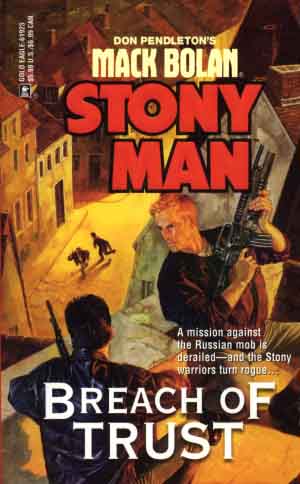 The Russian mob is attacked by Phoenix Force. Considering that a lot of their members are former KGB and GRU types, they know exactly who they are up against. So they set a trap up for them. Except only Able Team gets burned. They get burned hard. Harder than ever before. That Unomundo business? Since nothing changes the continuity in these novels anymore, this entry does give sweeping insight of a what if scenario. What would happen if Able Team died? Embarrassed and fighting mad, Phoenix Force and friends drop off the radar screen and use some sweet guerilla tactics to extract some payback. Because of his resources and allies, Rostoff has more insight and is therefore one of the more dangerous villians they’ve ever faced. He hurts them, and wishes to keep on hurting them. This is a struggle of ruthless people who won’t stop until the other is dead. They trap, ambush and screw each other up with improvisational attacks. It is also a struggle of corny language. The Hawkins inspired Southern witticisms would embarrass even Jeff Foxworthy. I also learned about the Stony Man religious doctrine and teachings referring to their “god of war.” Whether the god of war is Ares, Mars or Mack Bolan... by omitting their war god’s name and keeping it lower case letters, Stony Man appears to be practicing nondenominational worship. One of their truisms: The war god generally favors good causes. Um, yeah. I’m still trying to figure out who is this Lord of Illusion. And don’t get me started on cyberZen. Also Barbara Price should have been fired for her actions. There, I’ve said it.
 -
 “Salvador Assault” would be normally a routine mission for Phoenix Force. The writing has never been better. The action is notched up again. They make effective use of claymores in the climatic battle sequence. There are two things that are quite different. The focus on this one is with Encizo. I know he’s the focus right away, because he almost gets mugged in the beginning. He is also torn between a woman he sort of knows and his fellow Phoenix Force members. There are pretty angry words spoken between him and Katz. These comments are laced with ominous threats that threaten to fracture team chemistry. Another nice touch is at the end, when Encizo has a self-aware moment when he considers honoring an enemy’s request. Then there is Colonel Martillo. Martillo translates into hammer in Spanish. What a coincidence that his favorite weapon is the hammer. He is also a villain. He meets, talks to and interacts with Phoenix Force like an old episode of Columbo. We know he’s a villain, but he remains hidden in plain sight. This nice twist allows Martillo to have more information on Phoenix Force than the average terrorist leader of the month. Since this is an Encizo focused episode of Phoenix Force and there is a hammer-toting main bad guy, it leads to a very predictable ending to an otherwise stand-out entry.
 -
 Hardline Chinese commit terrorist acts using Western mercenaries and its up to the Chinese government and Phoenix Force to clear their names. This is a simple shoot ‘em up with a few things that improve upon it. John Trent returns. First time Phoenix Force goes to China, complete with a detailed travelogue and commentary on how terrible the Chinese are. Ironically, this novel was released at the same time the Tiananmen Square protests were occurring. TRIO is mentioned here because a remnant is represented. I liked this Fieldhouse entry, a bit by the numbers, but the fight scenes have never been sharper and the exposition writing is blending better with the story. There are a lot of things going for this intriguing foreign adventure.
 -
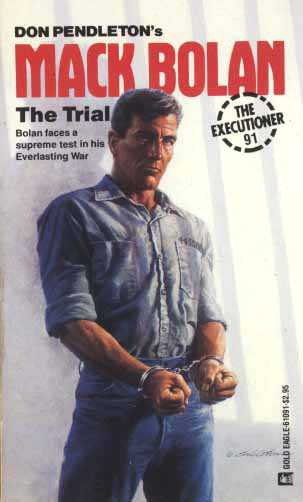 “The Trial” is a outstanding masterpiece. This is a direct sequel to every Executioner novel published up to this point. Ironically charged with a crime he did not commit, Bolan’s entire War Everlasting is on trial here. In the eyes of the prosecutors, he is perhaps the worst mass murderer in the history of the country. His entire testimony, on the stand, turns it around. I have reread the lengthy and powerful cross-examination several times throughout the years. The novel is an analogy, a defense of the entire series, of who the Executioner is. His moral code, his duty and his mission are exposed bare here in what is the ultimate characterization of Mack Bolan. The action is slight, no big deal. There are other novels in the series that cover this. This is about the exploration and a summation of the character is the true action. A rebuttal of critics, an affirmation for fans. This is the best written book of the series. This is also the first book to expand to approximately 250 pages, so it was an event novel. This entry will be followed by the superb and epic “Moscow Massacre” and a string of highly popular novels that would span from 91 to 101. In my opinion, this is the golden age of the Gold Eagle era’s Executioner.
 -
 Bolan’s mission to rescue Brognola from a biohazard “Lockdown” goes horribly wrong in this unique entry. The chapter two sequence was totally arbitrary and had literally no reference to the rest of the plot. And no reference is made to this previous action. It’s even more puzzling when it prefaces one of the more original plots of the Executioner series. What I like about the novel was the breaking of a mold. This is something he has never encountered and it is a treat to see Bolan figuring his way through a problem never seen or contemplated. Unfortunately, the novel ends with an unoriginal thud. Bolan has chased people before. I know what will happen. It also had a sizeable number of disposable characters who actually live. The violence was too restrained. Bolan and McCarter were packing pistols with only a couple of reloads. Their capacity for extreme violence was limited by a logical plot point. It had a lot of unanswered questions. The potential of this novel should have been mined, expanded and made into a SuperBolan. However, I liked several parts of this book. His friendship with Brognola is a true highlight of the book. Other books detail this friendship better, but here, its touching to the lengths Bolan would do for the head Fed. The scenes of horror, suspense and sudden violence were executed well. A word of warning. The novel ends at page 184. The rest is a preview of SuperBolan 100. However, this is not a shortened novel. The font and the words per page is denser than most other full-page novels, so we are getting roughly the same word count. If you still consider this a shortened novel after my argument, then you probably do not appreciate the Executioner novel lengths prior to the “The Trial” and you probably consider, like me, that chapter two was just another 7 pages of padding.
 -
 “Rolling Thunder” was a joy to read. It read like a true novel, a complete piece of work with characterization and detailed involvement on both sides of the law. The movements of Stony Man were as detailed as the movement of the BLM. In the opening encounter, Phoenix Force loses four members to various injuries: a stabbing, a shooting, blown hamstrings and a concussion. Able Team is down to two people because Schwarz was injured in prior action. We never see him. As Phoenix Force slowly recovers, Able Team picks it up where the others left off. The negatives about this novel? There are too many new people to keep track of. Since this is the more realistic of the Stony Man novels, people get away and have different sources of motivations. There is also a 25-page stretch starting at page 135 that almost killed my momentum through the book. This passage introducing four new characters, with motivations, agendas and plotting. It did not go anywhere. Once I moved pass this hump, the rest flowed downhill. Another negative would be the dumb coincidence of having an ill-fated BLM member to be assigned to that one room, never mind the number of hospitals and rooms in all of Spain. The odds of that happening, would be closer to winning the lottery. The last Ron Renauld novel I read was “Dead Zone”, an Able Team novel, seventeen years ago. He is much improved. His Able Team entries were, like this novel, strong in background, detail and dialogue. Unfortunately, they were also very light on the action and slight on scope. He has more action and more at stake in “Rolling Thunder” than his entire Able Team run.
 -
 I started reading the “Bolanverse” twenty years ago. “Chip off the Bloc” was my very first Phoenix Force novel that I ever read. I still remember every plot point, the level of detail and action. This novel succeeded in hooking me to this series and the rest. I thought the kid was too much of a cliché and every problem that I had with the novel flowed from him. Everything else, including mention that this isn’t the original team of Phoenix Force members, was compelling. I also enjoyed the pre-mission mission, involving the DARPA robot. Classic stuff, at least to me.
 -
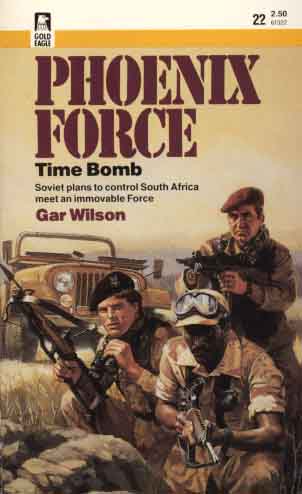 “Time Bomb” if picked up today, must be read as a historical novel. A detailed emphasis on South Africa’s problems before Mandela was freed, plays more like a history channel effort. The opening of the book is the stuff of Phoenix Force legend. Encizo is at near-death. Karl Hahn is brought in as a reserve member and as a possible replacement. Everything is up in the air, and since Able Team is busy, they are brought into the case of kidnapping in South Africa. Since they are recruiting a new member, temporary or not, a gun-battle takes place. The rest of it is by the numbers, sadly. Phoenix Force adapts well to their new roster change. Too well. After the initial shock and awe of possible loss and new additions, this entry devolves into one of their average, more predictable adventures.
 -
 “Weep, Moscow, Weep,” has the coolest name and cover art for a Phoenix Force entry. This is the companion book to “The Hostaged Vatican.” It resolves the cliffhanger of the previous book and continues on as a direct sequel, but from a new opponent. Trent is still with the team (the awesome cover gives it away) and Encizo and James are coping with their injuries. This entry is also a follow up to “Tooth and Claw” and several others. This entry has more continuity references than any other Phoenix Force title. Phoenix Force must wear masks and adopt colorful names to work with their enemies, the KGB, to stop TRIO from selling a stolen weapon. Firefights rage from the Gobi desert to Hong Kong. I liked the paranoid nature of Phoenix Force as they are fearful of a trap. They have a reason to be on guard. Only a year before, they sent three hundred men to kill them in the United States. Having them work together, even with contrived and bend-over-backwards explanations, still was a huge stretch. The action scenes were great. Fighting off the horde in the Gobi was unnecessary, but fun. I liked the enemy of my enemy is my friend plot here, because it plays well. This also finishes a nice, consecutive arc that stretches from #20 to this entry.
 -
 “Belgrade Deception” I would consider this to be the average, atypical Phoenix Force novel. By the numbers, carbon copy, replace earlier adventures with a travelogue on Yugoslavia.. and so on. The only kicker is that now, this novel is completely out of date. And the level of competition is sub-par. Phoenix Force versus the Albanian secret service? The action is usual Fieldhouse, but average. No lows, no highs. Nothing remarkable happens here. Phoenix Force kills some bad people. On a scale of 1-10, I would rank this a 5.5, right down the middle. I’m going to knock it a half point, just because of the quality of opposition. Those poor, poor saps never stood a chance.
 -
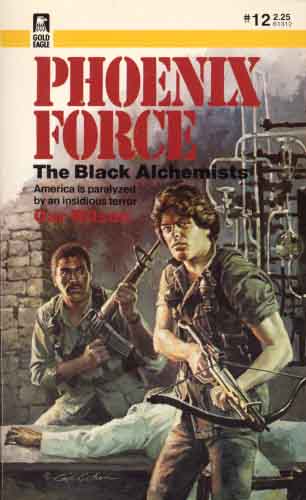 “The Black Alchemists” marks Phoenix Force’s first mission in the continental United States. It’s very rare for this team not to travel internationally. This time they are after The Black Alchemist terrorist group who performs terror through product tampering. This mission has several milestones that would permanently change Phoenix Force. This introduces Calvin James. It also kills off one of their original members, Keio Ohara. To kill of the main characters, Phoenix Force seperates itself from Executioner and Able Team adventures. Their members can be killed off and they continue to die off. And be hurt or crippled. Encizo here still suffers from the effects of being shot in the ankle. As of this writing, Phoenix Force looks remarkably different that the team that started out. They are dynamic in many ways. Ohara was memorable. So was his death. This is a must-read installment of the Phoenix Force series.
 -
 The multi-national anti-terrorist team Phoenix Force goes up against a multi-national terrorist group. We have the Basques, the Ninjas and the Muslims seize control of the Vatican. And they brought their earthquake machine with them… If I do not suspend disbelief, it would have been a disaster. But for some reason, I bought into this adventure. Encizo comes back. Hahn should have been hired permanently, because where is it written in stone that Phoenix Force has to be only five guys? After all, John Trent returns in this novel to be the temporary sixth member. The action scenes more than make up for the plot and dialogue. The torture scenes and terrorist tactics with the hostages are brutal. But I am more enamored with the concept, a prolonged campaign inside enemy territory confined to one geographic location. Phoenix Force is alone and they suffer serious setbacks. Ladies and gentleman, this is the first Die Hard. With mixed reservations, I declare this the best book of the Phoenix Force series.
 -
 “Aswan Hellbox” is one of the best Phoenix Force novels. It is a surprising, and welcome find to the uneven first ten entries. The plot is unique, to hunt down three hundred people across the nasty side of Africa to prevent them from blowing up the Aswan damn. 60-to-1 odds, even to Phoenix Force, is incredible odds. They make nice use of the Mark 19, 40mm grenade launcher. Without it, they wouldn’t have stood a chance. Also the terrorist leader stops at every village to loot, murder and maim. If he were to have kept going, Phoenix Force would have never caught them. In this novel, we also get more into the background of Manning.
 -
 “Return to Armageddon” is a pivotal book in the Phoenix Force series. If I was to introduce someone to the series, this would have been the first book to start with. The first ten entries were wildly uneven. Return to Armageddon is the first of eight in row by the same author. This mission starts as a Katz-centric mission, and ends up to be a personal mission for Encizo. He falls for someone. There is even a scene where he’s in bed, getting it on with a woman, with a Walther PPK in a shoulder holster nearby. How more James Bond can you get? But unlike Bond, he is not indestructible. Encizo gets so screwed up, he is limited in the next novel as well. This is also their first, but by far not their last, unauthorized mission. The novel is short, bloody and effective. This is where the series takes off.
 -
 “Missile Menace” was the first Phoenix Force novel by Mike Linaker. For almost two dozen novels up to the publication of this work, William Fieldhouse was The Voice of Phoenix Force. Bad writers that will not be named here but can be easily researched, were made even worse in comparison. What made it tough for Linaker was that developments were usually done with Fieldhouse. The death of Karl Hahn, etc. Linaker was not the lead novelist. With that handicap, I thought Missile Menace was a good start. I thought this novel was a hybrid of “Phoenix In Flames” and “The Doomsday Syndrome.” The writing was improved. Fresher. The action and plot were typical for Phoenix Force. But I knew there was only a status quo outcome in the ending. Linaker matches well with Fieldhouse. The Phoenix Force novels were in good hands until the end of its run. If it weren’t for the commercially disastrous and incompetent string of the last dozen Able Team novels, I believe Phoenix Force would have continued going well beyond the fifty-plus novels. One only wonders what would have happened if Linaker (or a writer of his caliber) had written for Able Team.
 -
 The title of “Power Gambit” has to be one of most boring of the series. I expect more from the author of “Weep, Moscow, Weep” As a novel, this entry was pretty good. Phoenix Force goes to Finland for a routine, shooting and scopolamine investigation. The big difference than all the other titles, except for “White Hell” is the survival aspect of the mission. Bones are broken. Killer wolves stalk them. And its super cold. Unlike the previous Alaskan adventure, nobody builds an igloo in this one. The Phoenix Force mission, average. Surviving the wilderness, priceless.
 -
 “Edge of Hell” has the most surreal Bolan experience I have read to date. The idea of a serial killer working up a corpse, only to have the worst luck imaginable to be in the one alley in the world that The Executioner chooses to use. Hilarity ensues. A good start to the novel. I also liked the wussy mastermind and the muscle’s power plays throughout; good characterization. Action scenes are above par. Bolan actually has a human body this time around, that have muscle pulls, aches and he’s genuinely concerned. Touching. When the action and storyline played out with the London cops, the plot dragged. It’s the only weakness to a superb adventure.
 -
 The first Super Phoenix Force, “Fire Storm” has to be the most over-the-top, insane Phoenix Force novel ever written. Everything is thrown into this. The kidnapping of the US and Soviet Presidents is not for a mere Phoenix Force entry, this is epic, heady stuff. The word count on this must be enormous. The kidnapping in the first hundred pages reads like an ending to an outstanding Phoenix Force novel. For such a world-shaking event, Able Team and Bolan had other things to do. They recruit former temporary member Karl Hahn, but he gets killed off, unexpectedly in the most horrific, thrilling send-off since Keio Ohara. I could never understand why Phoenix Force could up its membership to six instead of five, and let Hahn become a member. He was a member of the team for four novels. The same argument could have been made for Trent, except he never replaced anyone. In fact, thinking of it, didn’t they recruit Calvin James to be the sixth member of Phoenix Force? Since all the gloves were off, this became an event novel that anyone in Phoenix Force could be killed off. A must-read just for the permanent changes and nothing-can-top-this plot. This is the definitive Phoenix Force novel.
 -
 “Rim of Fire” makes “Show of Force” look like Fieldhouse novel. This was barely readable. This was a waste of a number. Phoenix Force exists in an alternate reality where the characters are different, act different, use their real names, call each other by their last names, and have slightly different histories. Fortunately, this parallel universe Phoenix Force is never seen again. Buy for the collection, do not attempt to read.
 -
 “Jungle Sweep” stars Rafael Encizo as a man on a mission to reunite with his brother in Mexico. It also stars the rest of Phoenix Force, but they’ve been reduced to cameos. A sequel to PF #29, The Nightmare Merchants, it shows permanent growth of Encizo as a character. It all leads to the inevitable, showdown with his brother. Phoenix Force does make an appearance, but its largely wasted, as if fulfilling a contract. Average entry but predictable, but a must-read for the series.
 -
 Weak entry in the Phoenix Force series by a first time writer. The opening premise of a Cheyenne in the Soviet Union, complete with American imposters is worth beginning the novel. The middle and end dragged and dragged. There was no coherent plot to follow. If you attempt to read this novel, and you make it to the ultra-lite sequence, you are a true fan. It’s not the typical Phoenix Force novel, more of an experiment. A failed experiment.
 -
 The Soviets are so upset that Phoenix Force had destroyed their laser shooting statue in India, their Krio Island facility in Greece and their drug running operation in Turkey, they launch their special forces squad into the United States to destroy them in “Tooth in Claw.” Instead of luring them into a trap, in say, Eastern Europe, they actually go to the U.S. where hardly anyone speaks the language. That’s the only knock against the novel I have. The novel is superior than other entries. Permanent developments occur as the KGB identify members of Phoenix Force, hitting them at their weakest points. They identify Gary Manning and they attack him in Canada. Instead of someone destroying the world, all the Soviets want to do this time around is kill off Phoenix Force. Or make them disband. Very ingenious plot indeed. Excellent installment.
 -
 “Night of the Thuggee” is where Phoenix Force head to India to deal with an ancient cult killing tourists. What follows is the standard shoot and scopolamine investigation. I liked the journey into the mountain darkness of India and their firefights along the way. What stops the show is what they find. A laser-shooting statue of Kali, the Thuggee’s idol of worship. It’s a classic Star Trek episode and a Destroyer novel, built into one. But it’s a Phoenix Force novel, so it was built by the KGB.
 -
 “Ninja Blood” is the fourth and final installment of the reoccurring Phoenix Force enemy known as TRIO. Instead of directing their actions from another country, the TRIO leaders are a little too slow and … that’s why this is the last TRIO story. MERGE never got a send-off like this. They just ceased to exist. And what a send off for TRIO. Good action sequences culminating in the destruction of TRIO. The plot is underestimated. Phoenix Force just has to show up and clear John Trent’s name. The rest is like “Tooth and Claw” for the good guys, where they hunt down and kill TRIO leaders because they are in the same country. Pretty straightforward. Pretty good entry with permanent results.
 -
 “Welcome To The Feast”, in addition to having the best title of any Phoenix Force entry, introduces TRIO (Japanese/Chinese/Mongolian mafias) and John Trent. Yes, I didn’t know Mongolia had a mob, but they are little more than warlords. The setting is San Francisco and since Calvin James just happened to be ex-SFPD, he calls upon his ninja buddy, John Trent. Trent reminds everyone else in Phoenix Force, eerily like Keio Ohara. The action scenes were enjoyable. The best part would be the entire “soft probe” sequence of the office building in San Francisco when they find out that MERGE is also after TRIO. TRIO will return in PF #19 MERGE will return in PF #23 John Trent will return in PF #26
 -
 “No Rules, No Referee” centers around Calvin James. A congressman visiting the Bahamas is killed by a criminal syndicate called MERGE. This is a new criminal organization who is comprised of several different mafias who survived the Executioner. They will make return visits in subsequent novels … only to drop off the face of the earth without a mention. The weakness of the novel is the point-A to point-B shootouts. Phoenix Force begins the mission by showing up to the last places the congressman visited and fighting thugs who try to kill them at every opportunity. The more places they visit, the action scenes improve. I would recommend this novel only by the action alone, the plot sags like a limp clothes hanger.
 -
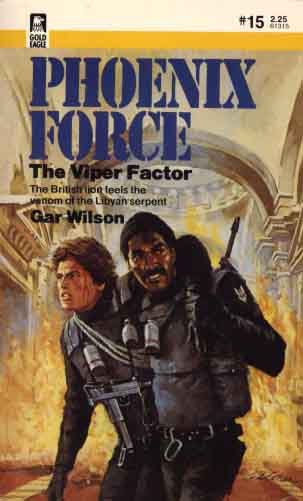 “The Viper Factor” would be the first, but not last unsanctioned mission for Phoenix Force. The action is standard stuff. There are a couple of skirmishes, but this novel basically has only one huge battle. The battle is sandwiched between two compelling mysteries, how would they get in undetected and how would they leave? “Viper” also gives a glimpse of the home life and background of McCarter. The novel was short, even with the padding. That includes a random street gang who attempt to mug a group of tourists answering to the general description of Phoenix Force. Now that’s pushing it.
 -
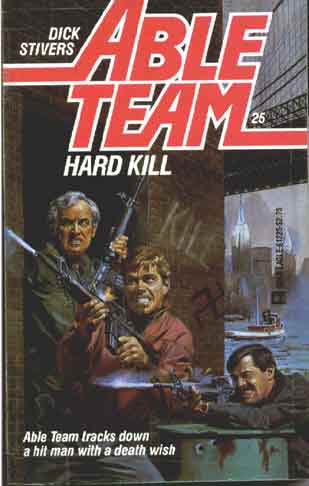 "Hard Kill" marks the complete transition from the GH Frost version of Chuck Rogers (the first) version of Able Team. Not only are the novels longer, they are starkly separate writing styles and plots. Instead of cover-to-cover action and terse writing, the author writes characterization, plot and motivation into a novel-long setup piece where it climaxes into a single, intense battleground that's all payoff. GH Frost was good and popular. He wrote epic Able Team. Anyone who replaces him as the series regular writer would be criticized by not following his formula. To me, "Hard Kill" is the most enjoyable, believeable entry of the entire Able Team series. Instead of untold number of killer hordes, Able Team is fighting a single killing machine equal and unusually elusive to them. As for the action scenes, the era of Rogers is quality over quantity. This is his best novel. 10/10.
 -
 Doom Prophecy was a well written and plotted entry. It's a welcome revival of the Golden Age of Stony Man from an author who obviouusly remembers the classic individual adventures of the teams. Every member of Phoenix Force and Able Team is given room to breathe, think and fight. There are a number of first-time events... action in every chapter. Phoenix Force is divided up from the start, literally covering more territory. Where one team is fighting, the others are recovering/prepping. The only weakness was that the villians' characterizations were a little too cartoonish. But this is cancelled out by the fact there were about five core enemies that could have each fueled a novel. More is richer. More please.