Reviews by
Adam Lounsbery
7 reviews
-
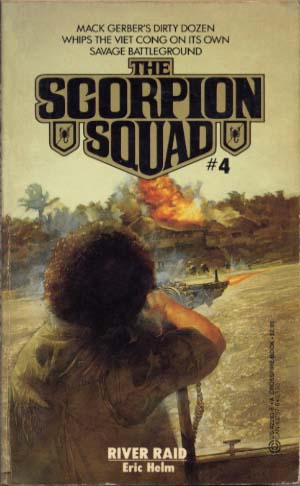 Another excellent entry in the Scorpion Squad/Vietnam: Ground Zero series. Some parts read more like an after-action report than they do a novel, but overall it's involving and well-written. There's a new character in River Raid who joins the Special Forces A-team at Camp A-555, who very well might be a vampire, and who's killed at the end by a VC booby trap; a wooden crossbow bolt through the heart. So that was weird.
-
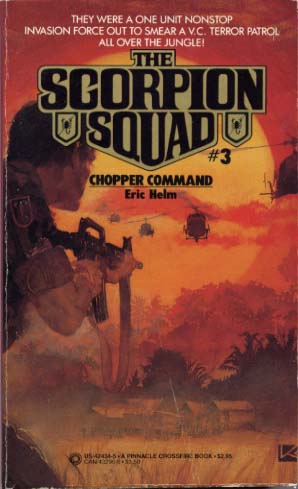 Another solid entry. This series keeps getting better. The action in Chopper Command is more realistic than in either of the two previous novels. Also, more attention is paid to the political situation on the ground, as opposed to the first two Scorpion Squad novels, which inserted action at every possible occasion, sometimes to the detriment of the overall story.
-
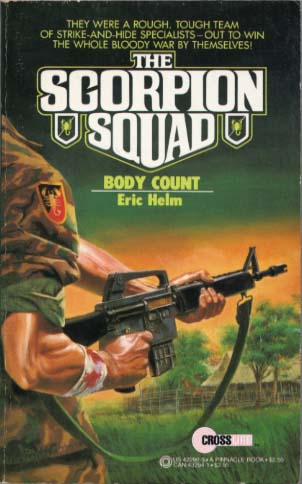 Body Count is good, but not great. The prose is at best workmanlike and the characters are mostly two-dimensional, but it does deliver a good story in a brisk and effective fashion. Ed Gorman called the Vietnam: Ground Zero series (which is what The Scorpion Squad series metamorphosed into after four books) "Some of the most riveting war fiction written..." Ed Gorman's not exactly Harold Bloom, but his opinion still carries some weight, so I'm looking forward to reading more of the series and seeing if it gets better. Judging only by the first book, this is a pretty standard mid-'80s men's adventure series, albeit one based more in historical reality than the Executioner or Destroyer series. (Body Count is set in the Mekong Delta a few months before the Gulf of Tonkin incident.) On the plus side, however, Body Count does a decent job of showing how insanely dedicated the Viet Cong were, as well as how disorganized and ineffectual the ARVN were, giving a certain sense of futility to the U.S. Special Forces' and LLDB's climactic victory.
-
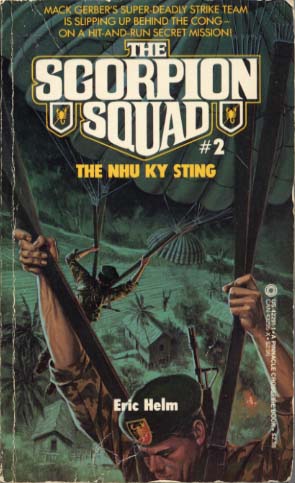 I enjoyed The Nhu Ky Sting a lot more than the first book in the series, Body Count. It’s more suspenseful, and the story has a more satisfying arc. In this one, Capt. Mack Gerber and his A-team are sent on a secret mission into North Vietnam to extract the pilot of a U-2 spy plane who was shot down and captured by the NVA. The writing in this volume is slightly better than it was in Body Count, but it’s still not great, and there are still bits of action that I find unconscionable in the context of supposedly realistic military fiction (like Capt. Gerber running between two of the enemy and then dropping to one knee so that they shoot each other), but in general the authors keep things relatively plausible. They also seem to be sticking to the historical timeline, and they come up with a relatively clever way to incorporate the 1964 attack on the USS Maddox in the Gulf of Tonkin into the fictional action of the book.
-
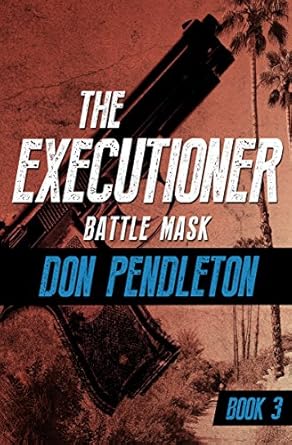 After his miraculous escape at the end of Death Squad (aided in part by Carl Lyons), Bolan is back on the trail of Mob boss Julian "Deej" DiGeorge. Unlike Death Squad, however, Bolan is on his own in Battle Mask. Although Pendleton’s third Executioner novel isn’t quite as good as War Against the Mafia, I think it’s a slight improvement over Death Squad. I prefer to see Bolan working alone, perhaps occasionally receiving assistance from sympathetic parties, but nothing more. Battle Mask is also quite graphic in its depiction of the fate that so often befalls Bolan’s friends. Dr. Brantzen, his old war buddy who gives him the plastic surgery necessary to infiltrate the DiGeorge family, undergoes the most disturbing and graphic torture seen in the series so far, getting himself sliced up into "turkey" meat. Sure, Bolan exacts swift and violent revenge (as shown on the cover of the novel), but nothing can chance the fact that a good friend of his was brutalized, or the fact that the friendly old man who drives Bolan to safety at the beginning of the novel pays for his kindness with a gut full of shotgun slugs. This book shows, as so many subsequent others do, that being Bolan’s friend is a dangerous job. Beside the return to the gritty and hard-boiled style of his first Executioner novel, Pendleton offers more suspense and tension in Battle Mask than he did with the continual shoot-outs and frontal assaults of Death Squad, which I consider a plus. Overall, a solid 9 out of 10 for a "Mafia Wars" book.
-
 A lot of people seem to prefer this novel to its predecessor, but I find this unfathomable. I thought that while Death Squad was exciting, and an enjoyable read, it measured up poorly to War Against the Mafia. After the grit and realism of that first novel, its sequel often seems almost cartoonish. The biggest stumbling block to my enjoyment of Death Squad, however, is the speed and ease with which Bolan is able to assemble his squad of fellow Vietnam veterans. Every single ex-serviceman he contacts is eager to join his war, and at no point does even one of them contemplate giving up. After the lengths that Pendleton went to in his first novel to paint a believable picture of a man who is driven to the edge by the deaths of his parents and sister, the introduction of nine new characters, most of whom are two-dimensional at best, seems somewhat ridiculous. Perhaps I would have had an easier time swallowing the action in Death Squad if Bolan had only recruited three or four old war buddies, and we had gotten more of a chance to know them. I liked “Chopper” Fontenelli, “Dead-Eye” Washington, “Pol” Blancanales, and “Gadgets” Schwarz, but didn’t feel as if Pendleton gave himself enough time to properly flesh out their characters. They emerge as dedicated and likeable soldiers, but that’s about it. The remaining members of Bolan’s hastily assembled squad are either total ciphers (like George Zitka), or gimmicky caricatures instead of real people. (Did we really need The Cowboy, The Indian, and The Hippy?) Aside from that, though, there’s little in Death Squad that I can complain about. The action is abundant, fast-paced, and well-written, especially the final pair of assaults on the Mafia. I liked the introduction of Carl Lyons’s character, and thought both scenes in which he meets Bolan face-to-face were tense and full of portent. Overall, I have to say that this a very enjoyable book, and a nice backbone to the “trilogy” formed by the first three Executioner novels.
-
 I remember reading a smattering of Executioner novels as a youngster, and--reminiscing about how much I enjoyed them--I recently bought a bunch of old Pendleton titles. Of the first several novels in the series, War Against the Mafia still stands out as my clear favorite. The action is hard-hitting, and the story moves quickly while still taking the time to establish the characters and settings. Another thing that struck me while reading this is how morally murky the Executioner's beginnings are. By that, I don't mean that Bolan himself comes across as confused or morally conflicted. Rather, the series of events that leads to him becoming The Executioner are realistically tangled. The mob doesn't kill his family--they drive his father to commit a terrible act of murder and suicide. His sister isn't forced to become a prostitute, she does so because she thinks she's helping her father and her family. And once Bolan infiltrates the Pittsfield syndicate, he grows to like and respect the man whom he originally most wanted to kill--Leo Turrin, who first ushered his sister into the mob's prostitution ring. All these moral ambiguities aside, what stands out most strongly in this novel is the savage purity of Bolan's warrior code, and his committment to eradicating the cancerous element of organized crime in the United States. Still, I like the little bits of depth and complexity that Pendleton gives to a story that mostly exists on a comic-book level. Also, there's still an element of tension in this novel as far as Bolan being a "wanted man" goes. In subsequent novels, he's able to avoid massive, nationwide police dragnets without breaking a sweat, but in War Against the Mafia, there's the sense that he's very close to being captured at any moment, which adds a great deal of suspense. For my money, this book is really about as good as pulp adventure writing gets.